
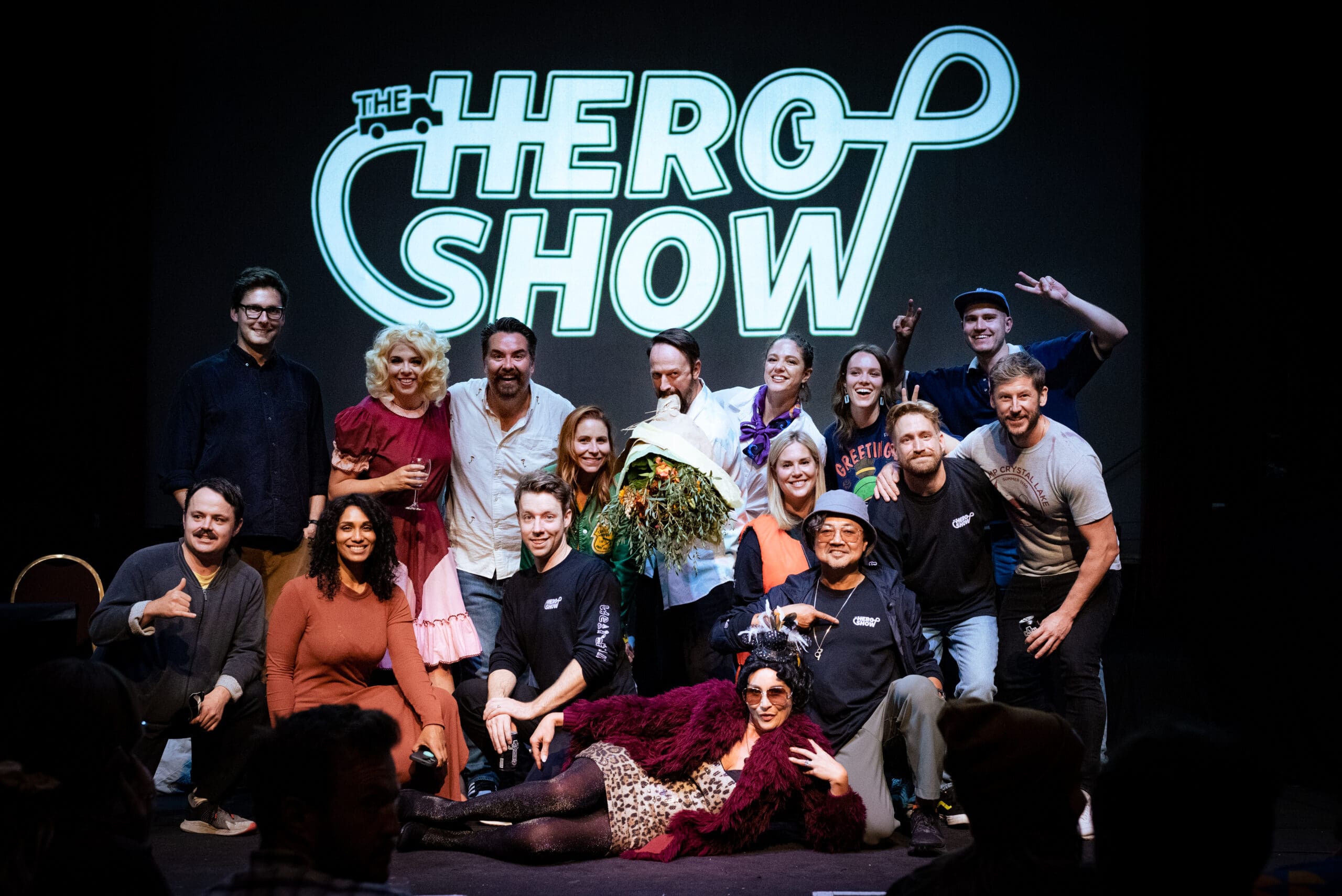
“The amount of people doing comedy right now is the most I’ve ever seen in Vancouver, by far, and I don’t know if that maybe has something to do with how dark the world has gotten,” says Cameron Macleod, host and producer of The Hero Show. The longest-running sketch-comedy show in the city, it’s always filled with funny folks doing solo performances of character monologues, songs, readings from fake books and other sketches that defy easy categorization. “There’s just a whole city full of weirdos doing fun stuff.”
Denise Jones similarly points to the bleakness of the world right now as a reason audiences are seeking out funny live shows for a few hours of escape. Jones is the cofounder of The Comedy Department, which puts on improv shows each week at the Show Cellar in the West End. “I think improv is still popular because it is so joyful,” she says. “The whole purpose of improv is saying yes to other people’s ideas.” She notes, “With Netflix and post-pandemic, I definitely think that comedy is experiencing a gigantic renaissance of interest from audiences.” And as we continue to spend more and more time staring at our screens, Jones predicts that authentic live experiences such as improv—where anything can happen—will become even more popular.
Local organization Blind Tiger offers classes in improv, standup and sketch comedy. Co-founder Tom Hill sees positive changes in Vancouver’s evolving comedy landscape, such as an increase in inclusiveness. “A big part of our mission of Blind Tiger is to welcome folks into comedy that were underrepresented in the scene,” he says. Shows featuring BIPOC and 2SLGBTQ+ performers are far more common now. Hill praises the venue Little Mountain Gallery in particular for creating a welcoming, affordable space that allows all sorts of creative people to make the work they want to make. “That’s so important to the development of comedians and voices in town.”
Vancouver also hosts several big events each year geared toward making people laugh. The Great Outdoors Comedy Festival in August attracts headliners such as Bill Burr, Anthony Jeselnik and Pete Davidson, while Vancouver Is Funny in September has featured the likes of Rick Mercer and Sophie Buddle. Just for Laughs Vancouver in February is the most established event of the bunch, with big-name performers such as David Letterman, Zach Galifianakis and Brent Butt.
That’s not to say the local comedy scene is entirely rosy. Oldtimers still lament the 2006 closing of The Urban Well, where Robin Williams sometimes did impromptu sets. The Comedy Mix shut down in 2019, and Yuk Yuk’s shuttered for good during the pandemic, leaving the city without a large, dedicated comedy club. The old system in which local standup comics worked regularly in these clubs—learning from more experienced comedians and gradually progressing from opener to feature performer to headliner—doesn’t really exist anymore. Instead, we have a mix of venues offering comedy just part of the time, along with an increasing number of TikTok and YouTube stars who haven’t had the chance to hone their acts by performing regularly in front of (sometimes unpredictable) live audiences. These social media stars also feel a constant need to pump out new content for their feeds.
“The lasting effects of the pandemic on the comedy industry, I would say, are the online nature of comedy has become front and centre,” says Ivan Decker, whose comedy album I Wanted to Be a Dinosaur nabbed a Juno Award in 2018. Online comedians are largely siloed from each other, whereas the old club system meant that young standups learned from more experienced performers, “watching what they do and how they work the very same audience in the very same room on the very same microphone that you just performed on,” which was extremely valuable, Decker says. “That’s happening less and less because of the fractured nature of the scene.”
“I think it would be better if there was a dedicated comedy club downtown,” says Jacob Samuel, who won a Juno Award in 2021 for his comedy album Horse Power. “There’s fewer opportunities for comedians to learn in a more structured kind of environment.” But, on the plus side, Samuel says the breakdown of the old system has removed many of the barriers and gatekeepers to comedy, resulting in a local scene that feels more accessible and diverse. “There’s more space for people who maybe felt marginalized before.”
Many of today’s Vancouver standups perform at Little Mountain Gallery, Comedy After Dark and Underground Comedy Club, all in Gastown. You might see an experienced performer polishing some material, a newbie at an open-mic night or shows such as Couples Clownselling—comedians and their partners get hilariously bad couples therapy from completely unqualified people—or Pillow Talk, a comedy show featuring classic slumber party games.
Brent Constantine, executive director of the not-for-profit Little Mountain Gallery, points out that although Vancouver has lost its big corporate comedy clubs, the unexpected silver lining is that the smaller venues springing up to replace them are less driven by profits. Many of these places are even run by comedians. Constantine says, “If you’re just trying to do comedy—standup, improv, sketch, other weird formats—it’s a great time to be in the city because there’s a lot of places that their first priority isn’t making money, but it’s in providing space for people to do what they want to do.” —Sheri Radford
share:

Be the first to comment