

For Tiffany Eichhorst, migraine was never “just a headache.” The debilitating neurological condition ultimately forced the former Cowichan Valley nurse to step away from the career she loved, highlighting the hidden toll migraine can take on work, mental health, and everyday life. As Migraine Awareness Month shines a light on this often-misunderstood illness, we sat down with Tiffany to talk about losing a profession, navigating an invisible disability, and why greater understanding in the workplace could change lives. —Noa Nichol
You spent years caring for patients as a nurse before migraine forced you to leave the profession you loved. What was the moment you realized your career was no longer sustainable?
I have spent my entire adult life going to school, writing exams, working, marrying, having children, supporting family and friends in my personal life, everything that anyone else does, and all while having a migraine. The message from my HCP & employer up until 6 years ago was, “There is not anything anyone could do for me,” so I just kept trucking along.
Living with migraine disease is my normal. It was my migraine physician who said to me after a tumultuous final year of work, “I think you are the last person to know you cannot continue this way.” I would have never come to that conclusion on my own. After my first six months off work, still of course continuing to have daily migraine symptoms, I realized I was chasing my tail and not doing myself any favours by sticking it out. There wasn’t a single moment, but a progression of failed so-called solutions.
Migraine is often dismissed as “just a headache.” What do you wish people understood about the reality of living and working through a migraine attack?
I don’t think you have enough space for me to tell you what I wish people understood because I feel this is one of the most underrepresented and misunderstood chronic diseases. I have migraine disease because it is a neurological disorder, not because I don’t (insert unsolicited advice here) exercise regularly, too much stress, eat seven almonds at sunrise facing NW, take an aspirin, or eat raw ginger.
The analogy of living and working through migraine is imagine you are by yourself in a jail cell, the lights are brighter than you can stand, the sounds are louder than you can comprehend, your waves of nausea feel like they will reveal the wrong smell or odour, only to find out you have to pretend you are ok. And what did that person say to me? Brain fog, complete exhaustion from the symptoms, and no one can see the jail cell around you while you continue your day. It feels heavy and isolating.
How did migraine affect your confidence, identity, and sense of purpose as a healthcare professional?
I’m a nurse. My confidence started to dwindle when my absences were so obvious to my work team, as I was perceived as unreliable, as I now know it’s the disease that is unreliable, not me, yet that is the very thing a nurse shouldn’t be. My identity started to change because I was no longer someone who could be counted on, and therefore, what was my purpose as a nurse if I was unable to fulfill these tenets? I wasn’t chosen for leadership roles any longer, or special projects where I knew I had value to offer. Professional development is a necessity to continue practicing and maintaining a license, and my sense of purpose was dwindling quickly as I watched my peers progress to higher levels in the profession and chase their passions. I felt envy. Nurses are problem solvers; yet I could not solve this problem.
Looking back, were there workplace accommodations or changes that might have helped you stay in nursing longer?
I left acute care bedside nursing to work in an office, one patient at a time, over the phone, no shifts, no physical exertion, less pay… hoping the change would benefit me, only to find that it didn’t make any difference at all. However, if I have to work longer, I think I could have done so by working from home.
Many people with migraine feel pressure to push through symptoms because the condition is invisible. How often did you find yourself masking your pain at work?
Every single day. For me, at the end of my career, I had an office which was easier on my senses than floor nursing, and one of the ways I would cope was to take my car to a nearby park, lock the doors, set my alarm, and nap for my lunch to hopefully make it through the rest of the day. Save my energy for the work, and the extra engagement with coworkers just drained my battery sooner than most, which at times may have made me appear aloof. I was just in survival mode. No lunches with coworkers, or walks on our breaks, I just didn’t have the bandwidth for it. I wanted it, I felt isolated and alone in a room of amazing human beings. I coped by presenting to my coworkers that I had a different agenda, ie, errands on my lunch hour, etc… I never told them I was napping.
Return-to-office mandates have brought many workplace triggers back into people’s daily lives. What are some of the biggest migraine triggers that others might not even notice?
The biggest triggers for me in a workplace are interactions with people. People living with migraine could also be sensitive to a scent (could be perfume or food…depends on the day), too much interaction with people without quiet breaks, and lights. The weather changes (wind, sun, rain, etc.).
Women are disproportionally affected by migraine during some of their busiest career building years. How do you think migraine shapes women’s professional opportunities and ambitions.
Sadly, the statistics show that women in general are the majority of the population for chronic illness. migraine disease clearly stunts women’s opportunities and ambitions. The commitment to higher education (time, money) and then onto meaningful employment and financial security is not a straight path because of the ups and downs of health. This leads to insecurity of income, independence and, often settling for lesser education (faster courses maybe a diploma over degree etc) and less demanding or rewarding careers. This may lead women to choose a 6-month course rather than a degree with a student loan they can’t repay because they could not complete the education or work long enough to pay it off.
I could not advance with my professional development due to my disability.
If a woman is single and with children, can you imagine the stress of trying to work and function with all the burdens of migraine? It’s insurmountable and yet we do it. Our earning power is diminished and so are our opportunities.
What surprised you most about the response you’ve received since becoming a patient advocate and speaking publicly about your experience?
In some professions, it is often like a small village despite the thousands of employees. The three degrees of separation so to speak, and with that when I became more vocal, I had nurses that I worked with, met, or they knew me from this place or that place etc. contact me. DM’s, emails, and ALL of these women had or had someone in their life with migraine and didn’t know it is a disease and recognized by WHO as such or that they could ask for help, time off, job accommodation etc. To these people, I became the first one to navigate the slow decline of my career and come out the other end as a nurse on disability. It is daunting the whole process. I was becoming a person that I needed when this was happening to me. That made me feel like I could at least do that for others. It shouldn’t be that hard. I have even begun to educate our Enhanced Disability Management Program (EDMP) leaders to resources through Migraine Canada, making it a default resource for people living with migraine when a Health Authority Employee has reported they need workplace support or need to leave work here in BC.
It is clearly that prevalent. The imbalance of the prevalence of the disease vs. the lack of support and resources can still improve.
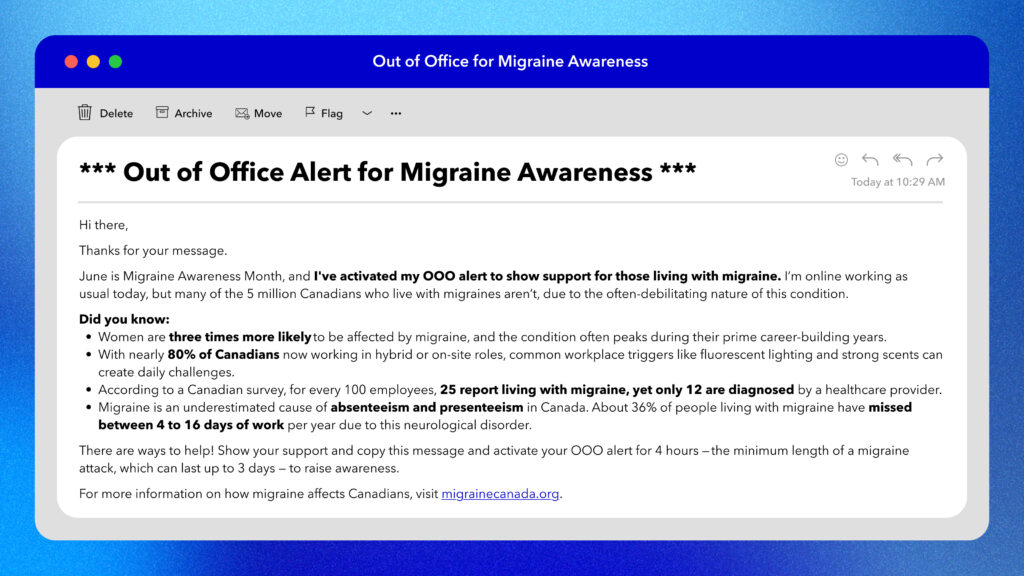
The Out of Office for Migraine Awareness campaign asks Canadians to set an out-of-office message for four hours—the minimum length of a migraine attack. Why do you think empathy-building initiatives like this are so important?
Everyone is carrying a burden of some kind, and no one can see what is weighing us down. We have a largely invisible disease and maybe just maybe with the fraying human connections due to screen times, our screens can represent us when our coworkers are unable to see for themselves as we work beside them daily.
Empathy building initiatives are important to start a conversation that hopefully leads someone to ask us what our experience is. Through this first step then maybe we can start making it personal, show the toll on the people, the families, the coworkers, the businesses that depend on us. It’s all a house of cards really. No employees, no profit, no services, no care etc.
For someone currently struggling to balance migraine and their career, what would you want them to know about advocating for themselves and seeking support?
Having an HCP as an advocate to help you navigate how you are able to work, have doctors’ notes supporting absences to show a pattern of illness that can support you if time off or other accommodations are required. Do not walk, run, to your HR or your branch of Disability Management for your workplace, so that you can use every tool available to you, remember you are not a burden, this is exactly why the department is there, to support the employee…. you! The more information you have about your options, the more proactive you are in your destiny, and you will have the paper trail to back you up and support you. With any luck, you may meet some empathic beings in your workplace who you don’t have to pretend you are not feeling well that day. It is nice to be seen.
share:

Be the first to comment