

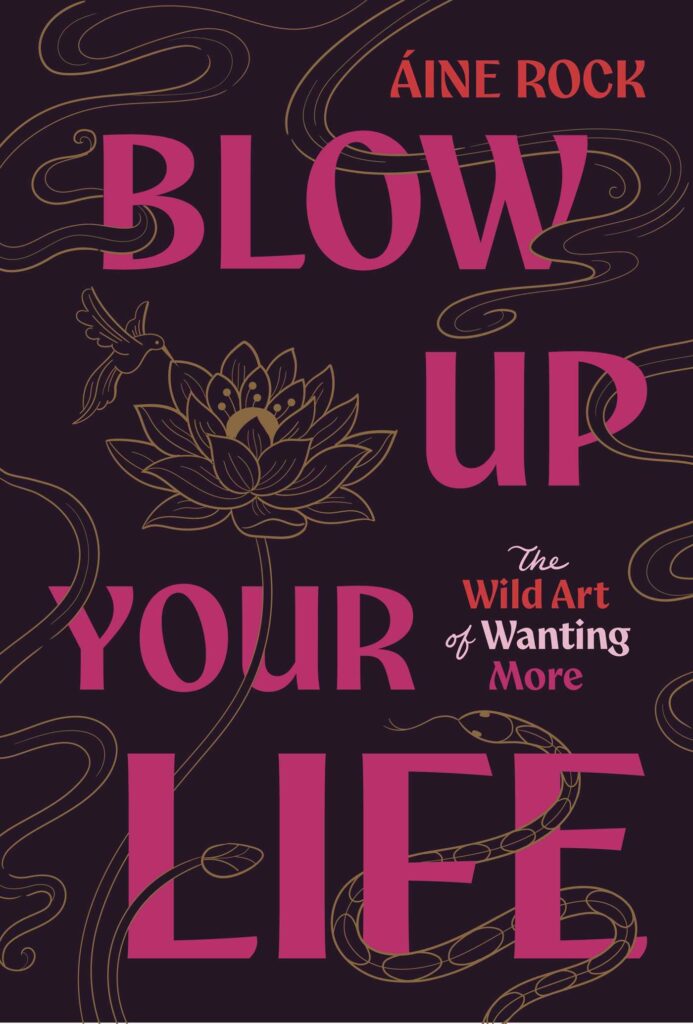
For many women, midlife arrives with an unsettling realization: somewhere between meeting expectations, caring for others, and doing everything “right,” they’ve lost touch with what they truly want. In her new book, Blow Up Your Life: The Wild Art of Wanting More (out July 7), author Áine Rock explores the quiet disconnect that can develop between stability and aliveness—and what happens when women begin choosing desire, pleasure, and self-trust over obligation. We sat down with Rock to talk about reclaiming identity, redefining fulfillment, and why wanting more might be the bravest thing a woman can do. —Noa Nichol
You write about women choosing the “path of least disruption”—when does that quiet compromise start to become a kind of self-abandonment?
So many women are buffering the energy of the home, keeping the peace, smoothing things over and what starts as well intentioned quickly becomes a habit we can’t get out of. It happens quietly and almost imperceptibly and before we know it we’ve made compromise a way of life
There’s a powerful idea in your work that nothing is “wrong,” and yet something feels deeply off—how do women begin to trust that feeling?
Trusting ourselves is such powerful work and many of us in midlife are relearning how to do it after decades of suppressing our needs and wants for the good of everyone else. But when something feels off and we ignore it, the body often begins to speak louder.
You draw a distinction between stability and aliveness—how can someone tell which one they’re actually living in?
I feel aliveness in my cells. And i’m not saying it can’t be found within stability, but when we trade our aliveness for the illusion of safety we suppress a vital current of life force.
Why do you think midlife, in particular, becomes such a pivotal moment for women to question everything?
I think we are peaking in midlife, emotionally and physically and for those of us that have raised children we are shifting our caregiving as they become more independent. There is a natural evolution that moves us into a new awareness and unwillingness to compromise our needs
The title Blow Up Your Life sounds dramatic—what does “blowing it up” actually look like in practice, especially for women with responsibilities, families, and careers?
It is provocative, but the subtitle — The Wild Art of Wanting More — is where the true essence lives. This is a return to something that feels more like remembering than learning. For many of us we titrate our way to bigger wanting. We start to trust our “no” again, and wait for a true signal of yes. That could start with saying no to the thing you’ve always said yes to, or booking the trip you’ve been waiting for permission to take. It’s telling the truth in the room where you’ve always stayed quiet. Some women do blow it all up at once — I did — but that’s not the prescription. There is no formula. What I will say is that the women I work with who are most afraid of blowing things up are usually already doing it internally. The explosion is already happening. The question is whether you’re going to let the outside catch up with the inside.
You talk about desire as something many women become estranged from—where does that disconnection begin, and how do we find our way back?
For many women in long term marriages, it happens so gradually they don’t even notice. She stops initiating. She starts withholding, not always consciously, but withholding becomes the one place she has control in a dynamic where she’s been giving everything to everyone. And then one day she looks up and realizes she has no idea what she actually wants. Sexually. Creatively. In every room of her life. Because if your entire pleasure coding, your whole sense of desire, has been built in response to someone else, in relation to what they want, what they’ll approve of, you don’t actually know yourself at all.
The path back starts with her. Her body, her pleasure, her sensuality, explored for herself first, not as performance, not as a gift to someone else. When a woman begins to discover what actually turns her on, what she actually craves, from a place of sovereignty, that’s when something real becomes possible. And from that place, she can choose to invite a partner in. But it has to start with her.
Pleasure as power is a radical reframe—what would change if women prioritized what feels good instead of what looks good on paper?
Following our pleasure feels radical because it is the opposite of people pleasing. It asks us to tune in and follow the current that is for us, even when it disappoints others. And that is genuinely threatening to a lot of systems, a lot of relationships, a lot of structures that depend on our compliance to function. A woman in her pleasure and in her power is harder to control. She’s following something deeper than being liked or keeping the peace. And once you’ve felt that, you can’t unfeel it.
There’s often fear around disrupting a “good” life—how do you help readers navigate the tension between gratitude and wanting more?
Gratitude and desire are not in competition, and I think the belief that they are is one of the most effective ways women are kept small. You can be deeply grateful for the life you have and still feel a hunger that that life is not feeding. Those two things coexist. The women I work with aren’t ungrateful. They’re starving for something that gratitude lists can’t fill. The work is learning to hold both — to bless what is and still reach for what’s calling you. Desire isn’t a criticism of your life. It’s a signal that you’re still alive in it.
Your work incorporates somatic insight—how does the body reveal truths that the mind might try to rationalize away?
The mind is an expert negotiator. It will tell you a thousand convincing stories about why things are fine, why you’re overreacting, why this isn’t the right time. The body doesn’t have that range. It just tells the truth. The tightening in the chest when someone says something that isn’t right. The way your breath catches when you’re about to betray yourself. The exhaustion that arrives not from overwork but from years of overriding your own knowing. My own body had been whispering for years before it started shouting. I developed a cyst on my left ovary — my creative center — and when they removed it I grieved, because some part of me knew it had been holding everything I’d refused to feel. The body is not subtle forever. Eventually it finds a way to make you listen.
For someone reading this who feels that quiet pull for more but doesn’t know where to start, what’s the very first, smallest step toward reclaiming themselves?
Name it. Privately, to yourself first. Saying it out loud seems so trivial but it’s a huge step, without needing to do anything about it. just let it exist. Then, write about it. Journaling is a powerful way to let our soul speak and track our wanting. Find a coach, a guide, someone whose entire job is to help you trust yourself. You don’t have to do this alone, but the person you bring this to matters. Let yourself be witnessed in your desire for more by someone who knows how to hold it with you.
share:

Be the first to comment