

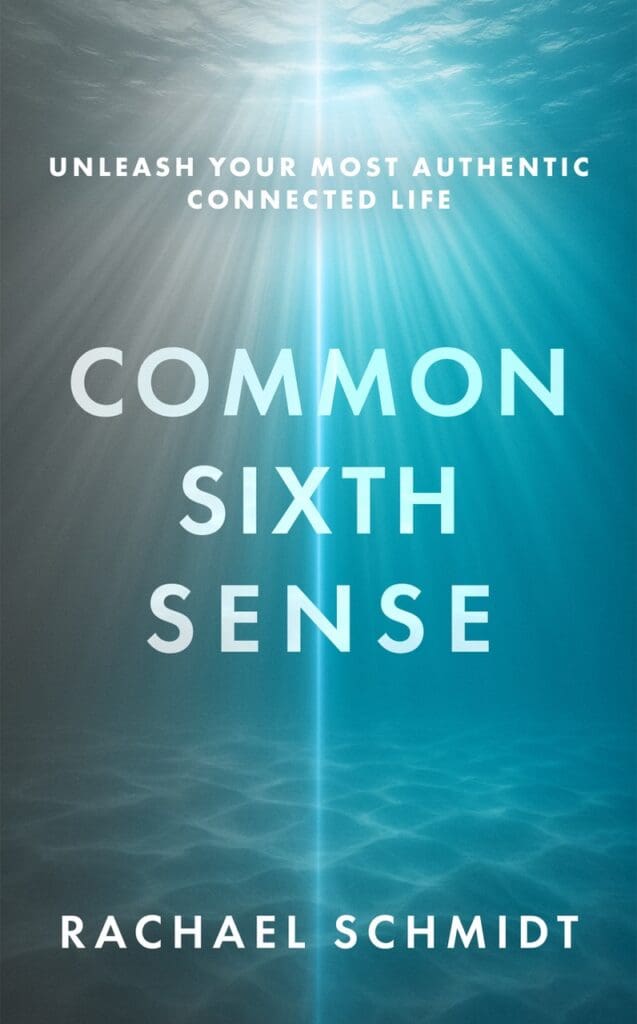
In a world that feels wired for distraction, Rachael Schmidt argues our best guide out of the noise is already inside us. In this Q&A she reveals what she calls the “common sixth sense”—the breath, intuition and energy-management tools we all have access to—and explains how small, everyday practices can shift chaos into calm. Read on for Rachael’s survival stories, her five-step jolt-to-action process and the simple rituals that make intuition a trusted, everyday resource. —Noa Nichol
Vita: You call intuition our “common sixth sense.” In one sentence, how would you define that idea for someone who’s never heard it before — and why “common”?
Rachael: Your innate abilities should be a common part of everyday living not just reserved for moments of revelation, but to guide you through every breath and experience of your life.
Vita: Your book grew out of personal survival moments where breath and inner guidance literally saved you. Can you share one story (in your own words) that best illustrates how the breath became a life-saving tool?
Rachael: My breath has always been there for me. It’s been a steady companion through yoga, parenting, and all of life’s chaos. But there was one moment when I truly understood its power. I write about it in my book COMMON SIXTH SENSE.
Years ago, during a home invasion, I found myself face-to-face with an armed intruder. I ran and hid in a closet, my heart pounding and fear running through every part of me. In that moment of absolute terror, something shifted. My breath found me.
As I focused on it, everything around me slowed down. That small act of breathing created just enough space for calm to return. My breath anchored me in my body and brought me into the present moment. I was able to be still and meet whatever came next with a kind of quiet strength I didn’t know I had.
That experience changed everything for me. I realized that breath isn’t just oxygen moving in and out of our lungs. It’s spirit, life, and peace waiting beneath the surface of chaos.
Your breath is sacred. It’s your truest ally. When you become more aware of it, you’ll notice how it steadies you and brings you back home to yourself. No matter what life brings, your breath is always there to guide you back to calm.
Vita: You developed a “theory of volatility” inspired by Einstein’s equation. Walk us through that formula in plain language — how does energy management predict whether we land in chaos or calm?
Rachael: After years of working with clients, I developed this simple equation E = mc². E is energy. M is your management or mismanagement of energy and C² is your chaos or your calm.
What this means is that how you choose to manage or mismanage your energy shapes the level of chaos or calm you experience in life. It’s really that simple.
Here’s what I suggest you do. Take a moment to reflect on your own volatility: how steady are you when your energy is tested? When you have a difficult interaction — say, with a demanding boss what comes next? Do you hold it in, vent to several others, snap at your partner or children, or end up with a pounding headache by the end of the day? These are all signs that your energy has been mindlessly given away instead of conscientiously guided. Chaos doesn’t just appear; it expands when we lose awareness of our energetic responsibility.
The beautiful truth is that you hold the power to change this. The moment you accept responsibility for your energy and how you carry it, direct it, and release it — the transformation begins. Calm isn’t something that happens to you; it’s something you create, moment by moment, choice by choice.
In COMMON SIXTH SENSE, I invite readers into that transformation through awareness, responsibility, and the peaceful strength that comes from honoring your own energy.
Vita: The book introduces a five-step “jolt-to-action” process. How does that sequence differ from common advice like “take a breath,” and what’s the first action someone should take in the first 60 seconds after a jolt?
Rachael: We’ve all heard the advice, “Take a breath.” It’s good advice but it’s only the beginning. What happens after you take that breath? How do you move from being jolted by life’s challenges to acting with clarity and purpose?
That’s where the Jolt to Action Technique comes in. It’s a simple, mindful process that helps you transform sudden emotional surges into calm, connected action.
Step 1: The Jolt — Feel It, Don’t Fight It
A “jolt” happens when something shocks your system — an argument, a tense email, a sudden scare. You’ll feel a rush of energy or adrenaline. Don’t resist it. Simply notice it and acknowledge I’ve been jolted.
Step 2: Breathe
Your breath is your anchor. Inhale deeply and slowly. Exhale with intention. Breathing begins to calm your nervous system and reconnects you to the present moment.
Step 3: Move the Energy Out
That surge of energy must go somewhere. Don’t let it get trapped in your body.
Visualize a dark cloud of energy floating out of you.
Ground yourself: imagine roots extending from your feet, releasing the energy into the earth.
Move: walk, stretch, shake it off or do whatever helps you release it safely.
If you’re driving, even pressing your palms firmly into the steering wheel can help channel that energy outward.
Step 4: Return to Your Body
As the energy dissipates, you’ll feel yourself coming back more grounded, centered, and present. Take a moment to notice: There I am. I’m home in my body again.
Step 5: Choose Conscious Action
Now you’re ready to respond — not react. From this place of calm connection, you can make thoughtful choices and take purposeful action.
A jolt followed by reaction leads to disconnection.
A jolt followed by conscious action leads to connection.
Remember the flow:
Jolt → Breathe → Release Energy → Return to Body → Choose Consciously → Act
Each time you practice this sequence, you train yourself to transform chaos into calm — one breath, one choice, one moment at a time.
Vita: Breath, intuition, body awareness — how do you combine these practically in a minute-long tool someone could use at their desk when anxiety spikes?
Rachael: When anxiety hits, your body, mind, and energy can feel scattered. It only takes a minute to reconnect. Here’s a simple three-step practice to help you ground, calm, and return to yourself right where you are.
Step 1: Breathe
Begin by gently focusing on your breath.
Inhale for a slow count of four.
Hold for four…
Exhale for four.
Repeat this rhythm several times, allowing your breath to soften and steady you. Feel your shoulders drop and your heartbeat slow. Each breath is a reminder that calm begins within you.
Step 2: Connect with Your Intuition
Once your breath has anchored you, turn inward. Trust that your intuition (your inner voice) is fully present and ready to guide you.
Remind yourself: I am supported. I do not have to navigate this moment alone.
Silently ask your inner voice to help your mind and body relax, to bring you back to peace. Give that inner guidance the love and attention it deserves. It is after all, the truest part of you.
Step 3: Tune Into Your Body
Now, notice your body. Where do you feel tightness, heaviness, or resistance? Send your breath to that spot and breathe into it, softly.
With each exhale, imagine the tension melting away. Feel the release, the surrender. Allow your body to let go, moment by moment. When you sense a subtle shift, your energy is softening and your presence returning. Gently open your eyes.
It’s remarkable how quickly connection brings calm. In just one minute, you’ve engaged your breath, intuition, and body and invited peace back in.
The Jolt to Action Technique can also support you here, helping you move that anxious energy out of your body and back into balance.
Your calm isn’t somewhere “out there.” It’s always within reach one breath, one moment of awareness and one act of self-connection away.
Vita: You teach mindfulness at the graduate level and coach Fortune 500 leaders. What’s the biggest misconception executives bring to mindfulness work, and how do you translate your methods for busy leaders who value metrics?
Rachael: I think one of the biggest realizations leaders have is that the ego must take a step back. It can be a humbling experience because self-connection isn’t something you can master through strategy or business skills. It’s not about figuring something out — it’s about feeling something deeper.
When leaders finally connect with their authentic selves, apart from their titles, achievements, or roles, it’s often a huge relief. They describe it as freeing. It’s like they finally get to meet themselves again, without all the expectations. Once they experience that sense of peace that comes from being fully present, they want more of it. They start to see how valuable that stillness really is.
What’s amazing is how quickly this inner work shows up in their leadership. The leaders I work with respond well to energy management. They start realizing that they set the energetic tone for their teams. If they are drained or unbalanced, that energy spreads.
As they become more mindful, they get better at noticing where their energy is going and how to protect it. They learn to give without emptying themselves. That kind of awareness changes everything — communication, morale, creativity, even team performance.
In the end, leaders must experience the benefits of mindfulness for themselves before they can truly inspire it in others. When they do, you can feel the difference in the entire organization.
Vita: Technology and social media are part of the “connection crisis” you describe. What digital habits make the biggest difference in restoring inner guidance — and what’s one tech rule you’d give listeners this week?
Rachael: Setting boundaries with technology is one of the most important steps in restoring inner guidance.
When we scroll mindlessly or spend excessive time on our devices, we may not realize it, but our energy begins to drain. We become overstimulated and disconnected from ourselves.
Notice the Shift
Begin by paying attention to how your energy shifts when you use technology.
There is always a moment (subtle but clear) when you start to feel off. Your shoulders may tighten, your breath may become shallow, or you might realize you can’t remember what you just looked at. You may stop feeling inspired, creative, or entertained. That is the moment of the shift — the point where connection turns into disconnection.
Create an Energy Shift Statement
Your Energy Shift Statement is a personal boundary designed to protect your well-being and help you reconnect before depletion sets in. It’s a simple, compassionate agreement you make with yourself.
For example:
- “When I start to feel the shift, I will set my phone down and take a few deep breaths.”
- “When my energy feels low, I will get up, stretch, or step outside for fresh air.”
- “When I notice tension in my body, I will pause the scroll and play music that calms me.”
The goal is to catch the shift early, before you’re fully drained. This practice helps you stay energetically aligned and in control of your attention.
Each time you reach for your device, ask yourself:
“Does this enhance my life right now?”
If the answer is no, redirect your energy toward something that nourishes you — a few deep breaths, movement, or simply a moment of stillness.
Your Energy Shift Statement is more than a habit; it is a promise to care for yourself. Treat it as an act of respect for your own energy and presence. The more consistently you honor this boundary, the more naturally your inner guidance will re-emerge.
Your energy is sacred. Protect it with intention, and technology will once again become a tool that supports your life rather than consumes it.
Vita: How do you measure progress with clients? What are the smallest signs that someone’s common sixth sense is becoming a trusted resource rather than an occasional intuition?
Rachael: I love seeing my clients start to set boundaries. That’s usually the first big shift. When people begin to manage their energy more intentionally, they naturally create healthier boundaries. They stop overextending themselves and start protecting their peace instead of reacting to everything around them. That one change can transform so much.
Once that happens, other things start to fall into place. They begin to take better care of themselves — and they do it without guilt. Their communication improves because they’re speaking from a calmer, clearer place. They’re less drawn to drama because, honestly, they just don’t have the energy for it anymore.
Their mindset shifts too. They become more open, grounded, and curious. Gratitude starts to take the place of scarcity, and they spend more time appreciating what’s going right instead of focusing on what’s missing.
As that awareness deepens, their relationships change. They attract people and experiences that match their calmer, more centered energy. You can feel it in the way they move through the world.
One of my favorite moments is when I’m teaching a class. I’ll say, “Okay, let’s close our laptops and close our eyes,” and I’ll notice that most of them already have. That moment says so much. It shows me they’re starting to trust themselves — that their intuition isn’t something they reach for occasionally, but something that’s becoming part of who they are.
Vita: For skeptics who say intuition is too vague or unreliable compared with data, how do you recommend they test and validate their inner guidance in a way that feels rigorous?
Rachael: I completely understand that. For people who are used to evidence and clear results, intuition can seem vague or even unreliable. But intuition isn’t the opposite of logic. It works alongside it. Logic gives us structure, and intuition gives us insight. Together, they create balance.
The truth is you can’t force intuition into a formula. It’s something you experience, not something you measure. It’s clear, natural, and fluid. Ignoring it would be like turning away from one of your most powerful internal resources.
For those who love data, I often remind them that there is a growing body of research showing how mindfulness and meditation improve self-awareness, decision-making, and emotional intelligence. These practices help quiet the mental noise so you can hear your inner voice. If you are curious, try starting with a short, guided meditation. Even five minutes can help you reconnect with that quieter wisdom inside you.
When you are faced with a big decision, use both your logic and your intuition. Do your research, gather the facts, and think it through. Then, before you make the final choice, pause and check in with yourself. Ask how the decision feels in your body and whether it aligns with your deeper truth.
As you build confidence, you can even try it the other way around. Begin with your intuitive sense of what feels right, then collect the data to see if it supports that direction. You may be surprised by how often your intuition and intellect end up pointing to the same answer.
Vita: Practical advice for our readers: give us three daily micro-practices — simple, specific, and time-bounded — that someone can start tomorrow to strengthen their sixth sense and manage energy better.
Developing intuition and managing your energy do not require hours of meditation or major life changes. The key is awareness, a gentle and consistent attention to your breath, your energy, and your inner voice. Try these three simple practices you can begin tomorrow.
1. Breathe with Awareness
Several times a day, pause and notice your breath. Inhale slowly through your nose, hold briefly, and exhale through your mouth. Feel your body begin to soften as you return to the present moment. Your breath is your reset button. Each conscious breath invites calm and clarity back into your energy.
2. Notice Your Energy
Pay attention to the moments when your energy shifts. When you feel a rush of irritation, stress, or overwhelm, stop and take a mindful pause. Breathe deeply, stretch, or move your body to release that energy before it builds. This simple act of awareness helps you move from reaction to restoration.
3. Listen to the Source
At least once a day, ask yourself, “Where is this message coming from?” Is it my phone, my thoughts, my environment, or my inner voice? Reflect on where you have given your energy away and where you have shared it with intention. This check-in strengthens your connection to your intuition, your common sixth sense.
Awareness is the foundation of intuition. When you nurture it through small and mindful moments, you begin to live with more peace, purpose, and energetic balance.
share:

Be the first to comment