

In an industry historically dominated by traditional palettes and even more traditional gatekeepers, Brittany Yeng didn’t just pull up a chair—she redesigned the entire table. The chemist-turned-attorney-turned-entrepreneur took a “skrewball” family idea and distilled it into one of the fastest-growing spirits brands in recent history, ultimately catching the eye of global giant Pernod Ricard for a majority acquisition. As we celebrate International Women’s Day, we sit down with the co-founder to discuss the raw reality of navigating the spirits world as a female founder, the high-stakes risk of betting on an unconventional flavor, and how she balances the velocity of an international brand with the grounded demands of motherhood. —Noa Nichol
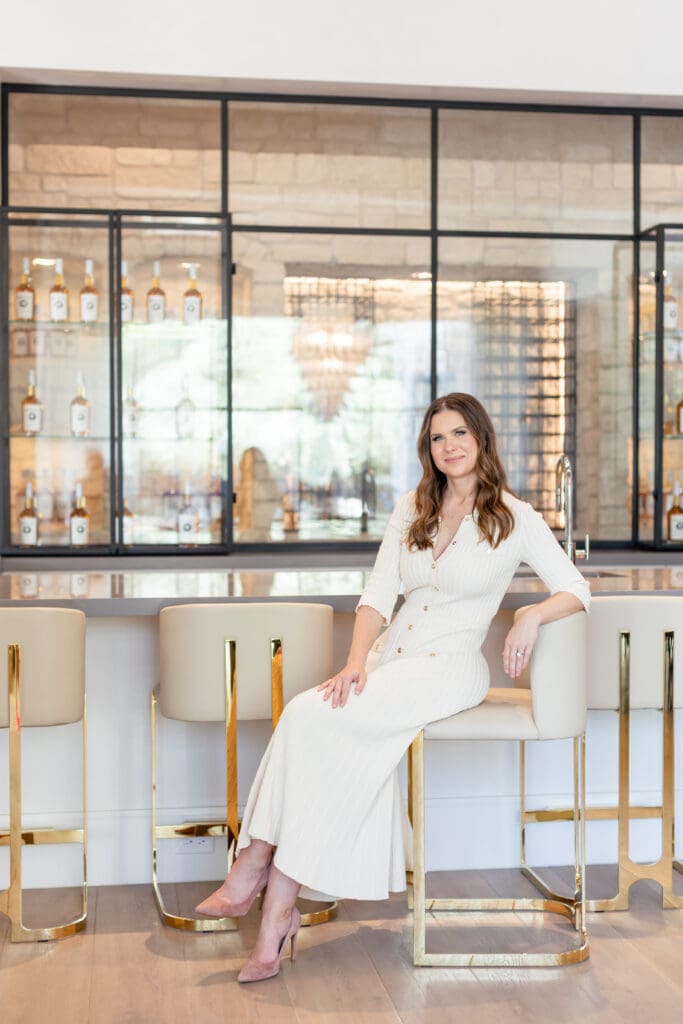
You’ve moved from chemist to attorney to spirits entrepreneur. How did your background in science and law give you a “secret weapon” when it came to the literal chemistry and the complex legalities of launching Skrewball?
I did not choose my background in chemistry and law with the idea of becoming a spirits brand owner. However, sometimes it works out that the unplanned works out better than any plan I could have made. My background in chemistry definitely came in handy in the early days of making Skrewball and the complexities of blending and filtration. And, my law background stepped in on the business side and tackling a very complex legal environment. The biggest advantage it gave me was knowing what the lawyers were not helping with. I have seen people sign absurd contracts from a business point of view because they thought the lawyers were advising and looking out for them on all those points. They are not. My law background didn’t give me all the experience of someone in the industry, but knowing where our weak spots were definitely saved us a few times.
The spirits industry has traditionally been a male-dominated space. Was there a specific moment in the early days where you felt your perspective as a female founder gave Skrewball a competitive edge that the “old guard” might have missed?
When we launched Skrewball, craft whiskey was big. Everyone was so focused on the details of making whiskey better from a technical standpoint that they forgot to step back and think about making whiskey accessible to a wider audience. That was the key to Skrewball. A common story we hear “Thank you for creating a whiskey I can share with my spouse.” Their spouse doesn’t like whiskey, but they like Skrewball. That was the exact insight I had when I would see people try Skrewball. We didn’t just make whiskey smooth, we made it delicious.
Many people initially thought peanut butter whiskey was too “out there” to work. How did you maintain your confidence in the brand’s identity when you were facing skepticism from industry gatekeepers?
Within every negative is a hidden superpower if you are willing to harvest it. So, we embraced all of the negative comments as the reasons we should succeed and turned it into our brand identity. We were the black sheep in the industry on every level from the way we looked to our backgrounds to the product itself. In fact, when we sought help from a consulting agency they turned us away. They told us we were a nice couple and the nicest thing they could do was to tell us to stop now and not waste any more of our time or money. We knew the odds were against us and no one expected anything from us or a peanut butter whiskey.
Instead of running from this fact, we wholeheartedly embraced it. We put a black sheep right on the label leading a pack of white sheep and called ourselves “Skrewball.” We knew that everything that made us different is what could allow us to lead an entirely new way of being in the industry. And, that’s exactly what we did.
Leading a small family idea to a majority stake acquisition by a giant like Pernod Ricard is the ultimate success story. How did you ensure that Skrewball’s “misfit” spirit and family-oriented culture remained intact during such rapid international scaling?
Success is a moment in time, and past success never ensures future success. We have to keep working and adapting to be successful. For us, it may look chaotic on the outside, but we have to have systems and processes that allow for the creative flow that got us to where we were. Partnering with Pernod Ricard, I have shifted from not just focusing on my creativity, but how do I help others foster their creativity.
You’ve balanced motherhood while building a global empire. What is the biggest myth about “having it all” that you want to debunk for other women entrepreneurs this International Women’s Day?
I was very lucky that from an early age my mom had dispelled many parts of the “having it all” myth for me. She would always tell me, “you can have it all, you just can’t do it all.” From an early age, my mom pointed out that many successful men have a spouse at home who is taking care of the family and that I need to build in that support if I want to be successful. So, I had that perspective from the beginning.
The problem is that I, and my kids, want me to do it all. Rather than feeling guilty by myself, I tried to turn it around into a learning opportunity. I have three girls, and I know one day they are going to have to navigate these same issues. We talk about the tradeoffs, and we discuss as a family what are solutions that can work. I have been so proud of my girls learning to speak up and tell me which events they really want me to attend and find solutions like calling Grandma when mom is not available.
Many entrepreneurs struggle with the “fear of the leap.” Looking back, what was the scariest risk you took with Skrewball that ended up paying off the most?
We had the ultimate “Skrew It” moment when we left our careers and leveraged everything we had to build Skrewball. I was a patent attorney at a big law firm, and my husband had built successful restaurants. Growing up, all my parents ever wanted for themselves and their daughters was some sort of financial security. They taught me that I had to work hard and keep working for a stable job. They were so relieved when I did. Yet, the cost of that “stable” job, was that I did not ever see my husband. As I was pregnant with my first daughter, I wondered how I would make that work.
I will never forget the day that I came home from my job and I had my infant daughter on my lap as I told my parents that the dream job that I had worked so hard for, I was going to walk away from. The look of sheer terror in my dad’s eyes and seeing his stomach drop is something I will never forget. But, after we talked he left with one last question, “Why haven’t you quit already?” It was not an easy road from there and we were struggling to pay bills for a long time. We had missed electricity bills and more, long after people thought we were “successful.” We got creative and were cashing out credit card points and finding every last dollar to make it work. But, we didn’t have a backup plan and we were going to find a way to make it work.
As you expand into new global markets, how do you adapt the “Skrewball” message for different cultures while staying true to the brand’s quirky California roots?
At the heart of Skrewball is a charmingly mischievous humor that is playful and breaks down barriers. But humor is personal. While it is so effective, it is the hardest tone of voice to get right as you move across different cultures and backgrounds.
From day one, we knew that the tone of voice needed to speak to a specific audience and not everyone, everywhere at one time. We adjusted to the moment, the medium, and the audience with localized humor. The message is the same, but the delivery is different. We love to learn about local jokes and humor and play into that.
If you could speak to a woman currently sitting on a “crazy” idea in a different industry, what is the one piece of advice you’d give her about claiming her seat at the table?
If you have a “crazy” idea, maybe you are on to something. The best ideas are the ones that no one gets until they see what only you can see. As we moved into the Pernod Ricard network and we learned about how they determine which products would come to market, I quickly noted that Skrewball would have never existed. Skrewball would have been squashed at the earliest stage because people didn’t know they’d like a peanut butter whiskey. I would ask yourself if it’s really crazy or if others just don’t see the value yet.
share:

March 1st, 2026 at 5:52 am
Brittany Yeng’s journey with Skrewball really shows how breaking norms and trusting your instincts can redefine an entire industry. Her science and legal background, paired with unwavering belief in a crazy idea, reminds us that innovation often comes from unlikely places and perspectives. It’s the same kind of bold creativity you see in other ventures that embrace uniqueness, like places that reinvent everyday experiences – whether it’s a bold new spirit or the fresh, flavorful twists at a spot like Salt & Butter where familiar ingredients are reimagined into something exciting and satisfying https://saltandbutter.us/