
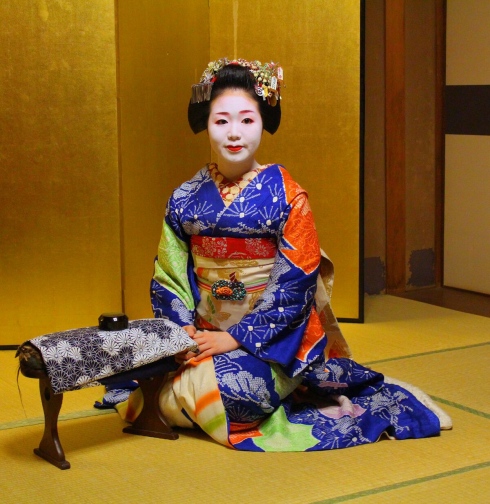
“Why did you decide to become a maiko?” my new Aussie friend James asked the young girl. At 15, maybe 16 years old, the porcelain white that painted her face did not mask any emotion. She responded with pride and confidence, in her mother tongue, and our Japanese guide translated: “It’s something I’ve wanted to be since I was a little girl.”

We were sitting in a tiny teahouse in Kyoto, in Western Japan—the birthplace of geikos (geishas) and maikos (apprentice geikos). The space was intimate, the size of a small living room. The décor, modest. Bamboo mats on the floor, a gold dressing screen at the back of the room. This simplicity was in stark contrast to the focus of the room—the maiko—who wore a bright, embellished kimono, her hair and makeup highly crafted.
Not many people have seen or met one of these Japanese cultural icons in person—there are less than 250 of them left in Kyoto and teahouses generally do not accept guests without references from other clients (however, if you do your research, there are a few hotels that will arrange the experience for you). In our case, the local Japanese guide we were travelling with knew the right people and was able to work his magic—even though “greeting a geisha” was not an activity listed on the official G Adventures’ tour itinerary.

Our maiko performed cultural song and dance, served tea and played instruments for and games with the group. Maikos are also known to be masters of the art of storytelling and can hold conversations about everything from politics and art to the rules of a drinking game. She shared stories about her family, her dreams, the camaraderie between herself and the other maikos. She answered every question and told every story with sureness. We were impressed with her confidence and talent.
Maikos are typically 15 to 20 years old, and “graduate” to full geiko status in their early 20s after completing their apprenticeship. They are completely committed to their profession; similar to Catholic nuns, maikos agree to remain single, and to live, study and work alongside their female peers. Many westerners assume that geikos and maikos are prostitutes but, though their job is to serve and entertain mostly male clients, whose attention and money defines these girls’ profession, this is not normally the case. In fact, Japan takes pride in its geiko culture and celebrates these women—a far cry from North America, where careers that exist to entertain men are often shamed.

This pride showed, very obviously, in our maiko’s impeccable appearance. Weekly visits to the hairdresser result in different types of elaborate Japanese hairdos using her own natural hair (once graduated to geiko, wigs are introduced). So intricate are these styles that a maiko must sleep on a wooden block with a pillow in order to maintain the shape.
Our time together was short, just shy of an hour. For the most part she was all business, playing the koto (a Japanese string instrument) and serving tea. These traditional acts, however, were punctuated by moments when she was engaged in conversation or posing for photos with our group. Our maiko giggled and made silly faces, reminding us that sure, she’s a Japanese cultural icon, but she’s also just a teenage girl. —Jennifer Foden
Photos by James Ramirez
share:

Be the first to comment