
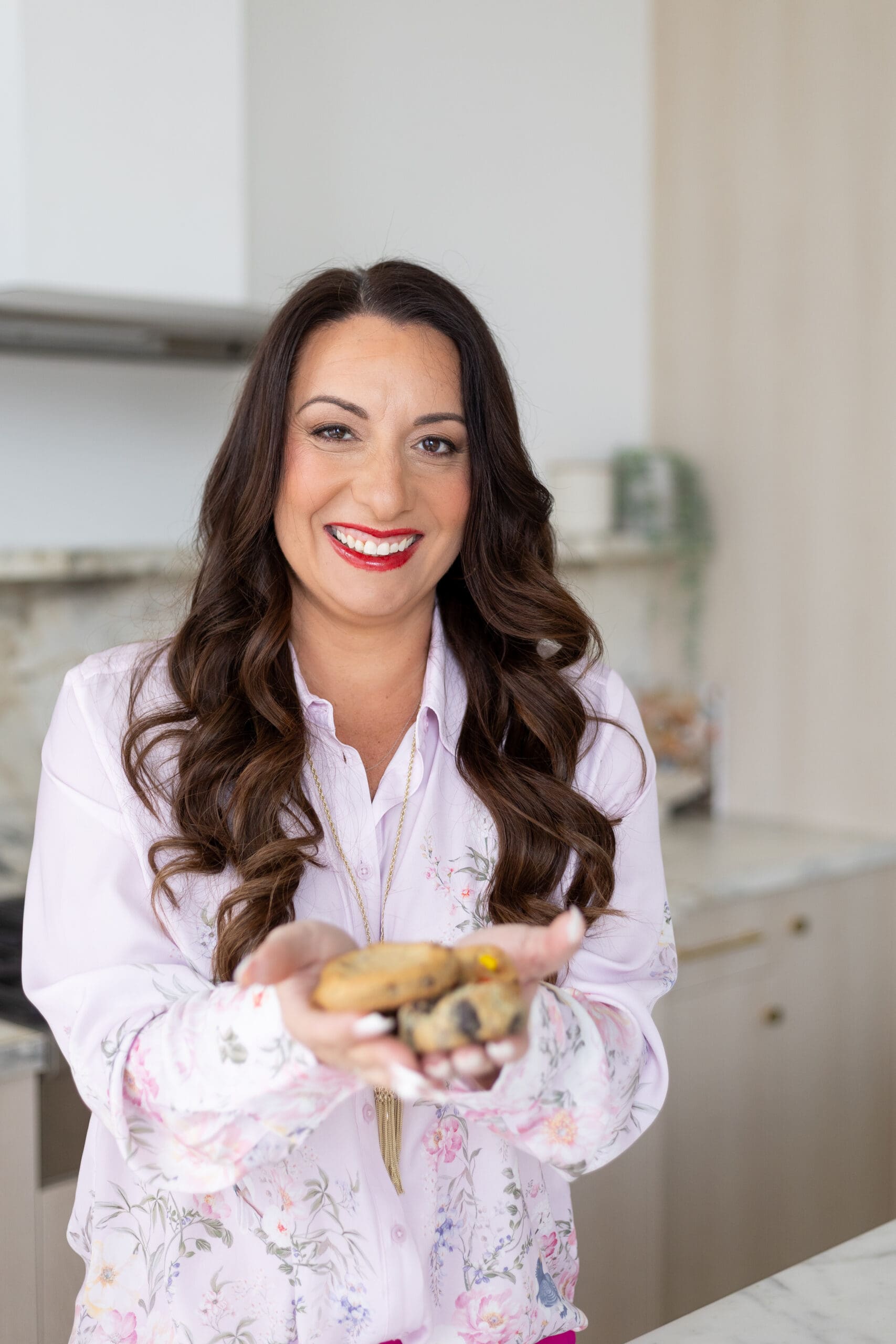
What do you do when the pressure to be everything to everyone catches up with you? For Alessia Di Cecco—a high-achieving executive, mother of two, and digital media powerhouse—the answer was surprisingly simple: start baking. In this inspiring Q&A, the Peak Performance Expert and founder of Sweet Tavolo shares how stepping away from the boardroom and into the kitchen became a life-changing act of self-care. Ahead of World Baking Day and Mental Health Awareness Month, Alessia gets candid about burnout, balance, and the healing power of flour, butter, and saying yes to joy. —Vita Daily
Let’s start with burnout. What was the moment you knew something had to change—and how did that experience shape the leader you are today?
The funny thing about burnout is that it doesn’t happen all at once. It’s like a cake left in the oven too long. At first, everything looks fine. But the longer it bakes, the more it starts to burn—until the smoke fills the room and the fire alarm goes off. For me, the alarm sounded during a quiet moment in my manager’s office. She asked me a simple question: “Are you okay?” Normally, I would’ve smiled, nodded, and said, “I’m fine.” But this time, something cracked open. I took a breath, and for the first time, I said the truth: “I’m not okay.” That single moment of honesty changed the trajectory of my life—and the kind of leader I’ve become. Because what I’ve learned is this: burnout doesn’t always look like collapse. It often hides behind high performance, people-pleasing, and polished smiles. We never really know what someone is carrying beneath the surface. So now, I don’t just check in—I really check in. I don’t assume “I’m fine” means someone’s okay. I listen more. I lead softer. I ask better questions. And most of all, I try to be the kind of leader I needed when I was burning at the edges and too tired to ask for help.
Baking as a burnout recovery tool is unexpected. What drew you to it, and how did it help you process the pressure and anxiety?
I come from a long line of Italian women who spoke their love through food. Hands in dough. Sauce simmering. Cookies wrapped in parchment and care. The kitchen was always more than a place to cook—it was where we gathered, recharged, and felt held. Some of my earliest memories are of standing beside my grandmother as she made something magical for our family. My first baking memory? Making brownies with my mom—a simple, sweet recipe, just right for a six-year-old with sticky fingers and big curiosity. As I got older, baking became something else entirely. It became my escape. A way to unplug. To follow a recipe when everything else in life felt chaotic and unclear. Baking gave me a rhythm. A sense of control. A pause. It became the thing that grounded me when I was overwhelmed by the pressure to be everything, to everyone. For me, baking is like a zen garden—a place where I can be fully present, creative, and calm. When burnout stripped away so much of my energy and joy, the kitchen gave me a place to return to myself.
You went from managing multimillion-dollar accounts to launching an online bakery. How did Sweet Tavolo come to life, and what role does it play in your life now?
Sweet Tavolo started quietly—like many meaningful things do. It was born from my entrepreneurial spirit during a time when I had intentionally stepped away to recover and reconnect. I wanted to share my baking beyond my own kitchen. So that holiday season, I decided to make my signature gingerbread cookies as a thank-you gift for my son’s teachers and support staff. I packaged them in simple, sweet bags and handed them out at the parent bench lineup. Then I shared a few photos and videos on Instagram and Facebook—nothing fancy, just something from the heart. A few days later, a fellow mom reached out and asked if I could make cookies for her holiday party. And just like that—Sweet Tavolo was born. What began as a personal creative outlet quickly grew into a business rooted in joy, generosity, and celebration. Today, I run Sweet Tavolo as an online bakery, creating custom cookies, cakes, and treats for special events and moments that matter. It’s more than a side hustle—it’s my way of spreading warmth, beauty, and a little sweetness into the world, one table at a time.
You talk a lot about “nourishing” high performance. How can business leaders redefine productivity to include rituals that support their well-being?
We’ve glamorized burnout for far too long. Somewhere along the way, we started confusing productivity with self-worth—measuring value by how much we can cram into a calendar, how many hours we stay online, or how quickly we reply to every message. But true high performance isn’t about how fast you move—it’s about how well you recover. If you want to lead at a high level and sustain that level, you need rituals that nourish you—not just systems that squeeze you. For me, that looks like baking. For others, it might be walking meetings, silent mornings, five-minute breath resets, or boundaries around after-hours communication. The ritual doesn’t matter—the intention does. As leaders, we need to normalize rest as a business strategy. Because when you treat yourself like a machine, you burn out. But when you treat yourself like a recipe—something to be balanced, protected, and refined—you rise.
As a former Junior Olympian, you’ve been in high-performance environments since childhood. How has your view of success evolved over the years?
As a former Junior Olympian, I was trained to equate success with winning—with podiums, rankings, medals, and measurable outcomes. And for a long time, I brought that same mindset into my career. I chased the next promotion, the next project, the next milestone, always trying to prove I was enough by producing more. But high performance without inner alignment will eventually burn you out. Burnout forced me to rethink everything. It asked me not just what I was achieving, but why—and at what cost. Today, success looks very different to me. It’s not about being everywhere for everyone. It’s about being present for the things that matter most. It’s about taking the time to evaluate what you are doing and if it is in alignment with your core values. Using the word “no” to protect your rise. It’s not about doing it all—it’s about doing the right things, with integrity, intention, and joy. I still have ambition—that part of me hasn’t gone away. But now, I measure success not just by outcomes, but by how I feel while I’m creating them. Because if I lose myself in the process… what am I really winning?
Mental Health Awareness Month often focuses on rest, but you say it’s also about creativity. Why are creative outlets so essential for leaders?
Mental Health Awareness Month often centers on rest—and rightfully so. But I believe creativity is just as vital, especially for leaders. Why? Because leadership is often measured by outcomes: goals hit, targets met, boxes checked. We spend so much time chasing the next win, the next milestone, the next measurable result—it can be exhausting. Creativity offers something different. It’s not about performance. It’s about presence. The dictionary defines creativity as “the ability to bring something new into existence.” That might be an idea. A solution. A piece of art. A new way forward. There are no rules. No judgment. No quarterly metrics. Just freedom to explore. To play. To think differently. For leaders, creativity becomes a form of release—a mental reset that reconnects us to imagination, curiosity, and joy. And the irony is, the more space we give ourselves to create without pressure, the more clarity and innovation we bring back into our work. So yes—prioritize rest. But also make room to make something. Paint. Write. Cook. Garden. Doodle. Because creativity is recovery in motion.
What’s the connection between baking and leadership? Are there lessons from the kitchen that have surprised you in how they translate to team dynamics?
At first glance, baking and leadership might seem worlds apart. But the more time I spend in both spaces, the more I see the parallels. Baking is about intention. It’s not rushed. It’s measured. You don’t throw everything into a bowl and hope for the best—you follow a process. You pay attention to balance, to heat, to timing. Leadership is the same. You can’t just pile on pressure, mix in demands, and expect people to thrive. You have to be thoughtful. You have to know when to step in—and when to give something space to rise. In the kitchen, I’ve learned that too much of any one ingredient can ruin a recipe. And in a team, too much control, too much ego, or too much silence can do the same. Baking has also taught me patience. Humility. The value of trial and error. Not every batch turns out perfect—but every one teaches you something. So yes—there’s a connection. Leadership, like baking, is about care. It’s about creating the right environment for people to rise.
You now speak about building more connected workplaces. What’s one simple but powerful practice any team can adopt to build stronger relationships?
If I had to distill it down to one practice, it’s this: Treat your people like they matter—and show them consistently. That might look like investing in their growth. I’ll never forget when I felt stagnant in a role and my manager suggested I pursue a Project Management certification at Rotman. That one gesture made me feel seen, valued, and reinvested in the company. It might be meaningful recognition. I had a leader who made a point to celebrate my contributions not just over email, but in person—in front of senior leadership. That kind of advocacy stays with you. It might be intentional check-ins. I hold monthly one-on-ones with my team, where the focus is them—not deliverables. We talk about wins, roadblocks, and whatever else they need to bring to the table. Or it might be something as simple as a team name—something we build together, something we rally behind. That shared identity fosters belonging, even when the work gets tough. Ultimately, connection is built in the little moments—the ones where people feel heard, seen, and supported. As a leader, you can’t outsource that. You have to live it. Lead by example. Invest in people. And don’t just talk culture—bake it in.
What’s your personal “recipe for resilience”? What are the non-negotiables in your day-to-day that keep you grounded and joyful?
I love this question—because I really do think of resilience like a recipe. It’s not about one big, dramatic ingredient. It’s about the little things you mix in daily, consistently, with care. For me, the non-negotiables are simple, but powerful: Family—my why, my anchor, my daily dose of perspective. Friends—the ones who remind me who I am when I forget. Movement—whether it’s a workout, a walk, or a dance party in the kitchen, I need to move to stay grounded. Smiling—it might sound cheesy, but joy is a discipline. I look for moments that make me laugh, pause, or soften. Some days, I get the mix just right. Other days, it’s messy—but I keep showing up to the kitchen. That’s resilience to me.
And of course, we need to ask—what’s your favourite recipe from Sweet Tavolo to bake and share, and what makes it so special?
Without a doubt, it’s my gingerbread cookies. The recipe was passed down to me from my Swedish nannie, and I’ve been making them for over 40 years. They’re not your typical North American gingerbread—hard and brittle. Mine are soft in the center, crispy on the edges, full of spice, and made with so much love. They’re decorated with care, always—because that’s part of the ritual too. And honestly? They’re kind of like me. Warm, a little spicy, crafted from generations of love—and best when shared.
share:

August 18th, 2025 at 7:15 pm
HONDA4D
September 24th, 2025 at 12:47 am
To play. To think differently. For leaders, creativity becomes a form of release—a mental reset that reconnects us to imagination, curiosity, and joy. And the irony is, the more space we give ourselves to create without pressure, the more clarity and innovation we bring back into our work. So yes—prioritize rest. But also make room to make something. Paint. Write. Cook. Garden. Doodle. Because creativity is recovery in motion.