

The short-form video world is clocking at lightning speed, where attention spans are dwindling, and content creators must win hearts within seconds. Short-form videos are rewarded by platforms for their straightforwardness, and that’s where micro-stories fit the bill. Micro-stories are stories that are condensed into under five seconds, at times powered by cutting-edge edits that leave audiences laughing, gasping, or swiping back to rewatch.
Pippit simplifies this art. With its user-friendly editing capabilities, producers can turn raw footage into stop-in-your-scroll micro-stories. Beginners can even take an ordinary clip and turn it into a punchy story. And with a video cutter implemented in Pippit’s dashboard, you don’t require sophisticated software to make an instant impact with minimal time.
Why five seconds is enough
A five-second clip may sound like too little, but in reality, it’s just the right length to tell a story when framed correctly. The trick is to strip everything down to its essentials: one setup, one action, and one payoff. That payoff could be a surprising twist, a comedic punchline, or even a visually stunning shot.
Consider micro-stories as haikus on the internet, short, formatted, and powerful. Rather than dwelling on foreplay, you proceed to the denouement. The reader doesn’t need an introduction; they need the payoff.
The anatomy of a micro-story
All micro-stories, however brief, retain the three pillars of narrative:
- Setup: The opening camera introduces the environment or personality.
- Conflict: Something violates expectations to shift the tone.
- Resolution: The conclusion provides a payoff, a laugh, or surprise.
It takes less than five seconds to accomplish, but the emotional journey remains. By learning cuts, you can take people through these stages before they even know it.
Micro-stories as branded content
Brands can leverage micro-stories to present a product or campaign in a playful, engaging manner. A coffee brand, for example, might depict beans dropping, segueing into steam rising, and closing with a happy sip, within the span of five seconds. No voiceover is required, just clean visual storytelling.
This is particularly suitable for platforms such as TikTok, Instagram Reels, and YouTube Shorts, where brevity and creativity are valued above lengthy ads.

Playing with time in reverse
Another witty strategy is applying Pippit’s video reverser to bring surprise. Picture a spilled beverage coming magically back into its container or a skateboarder’s crash becoming a flawless trick when reversed. Reverse narrative can condense humor, awe, or even an otherworldly atmosphere into seconds.
When inverted clips are merged with crisp forward cuts, they produce a fresh rhythm that is replayable. People tend to view twice, once for shock, again for details, which doubles your effect.
Fun three steps to cut like a pro with Pippit
Step 1: Open video editor
First, create an account on Pippit to view its dashboard, select Video generator from the left menu, and then click on Video editor. Click Click to upload to upload the video you wish to trim, or simply drag and drop it into the editing interface.

Step 2: Use the video trimmer tool
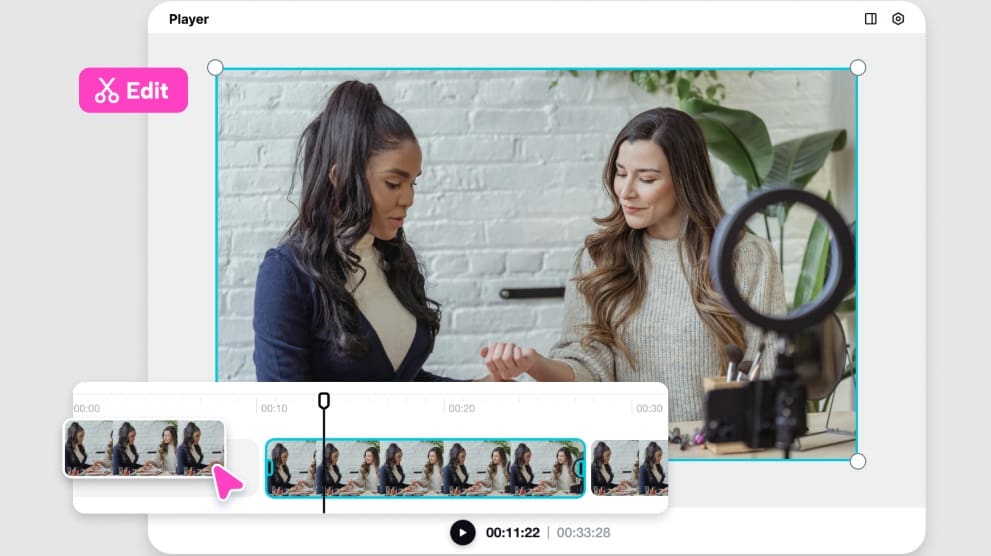
Next, click on the video in the timeline and move the transform handles at the beginning or end to cut the video. To cut away an unwanted scene in the middle, move the Playhead to that frame and click Split. Delete the unwanted clip and your video will be trimmed to perfection.

Step 3: Export or share the trimmed video
Finally, press Export in the top right of the editor interface, select Download, select resolution, format, frame rate, and quality, and then press Export to save the video. Alternatively, press Publish to post the content directly on your social platforms.

The role of sharp editing
Editing is the difference between making a micro-story and breaking it. Without cutting on its toes, the rhythm disintegrates. The viewer gets bored, and the essence goes missing. With tools such as Pippit, creators are able to cut seconds with precision to ensure that every frame matters.
Cutting is not about shortening; it’s about reshaping time. By eliminating unnecessary frames, you advance the action, increase the tension, or deliver the punchline harder. It’s the digital version of storytelling minimalism.
Bringing stills to life
Micro-stories don’t necessarily start in video form. Most start with static images and are brought to life by an image to videoprocess in Pippit. Proper pacing and even a single image can be made into a five-second story. A product shot can zoom dramatically, cut to a reaction, and conclude with a tagline, for instance. Instantly, a plain picture tells a full story.

Why micro-stories go viral
Short-form sites pay for watch time and replay value. A quick five-second tale is more likely to get repeated views because it doesn’t take much effort to view. The algorithm picks up on this and continues to send your content down the road.
Micro-stories also have the benefit of being shareable. A friend can share a five-second clip without fear that the viewer will skip over it. This makes micro-stories great marketing tools, particularly for small businesses and indie creators.
The creative challenge
Learning to tell five-second stories is no cakewalk. It makes creators think twice about what they can and cannot cut. Each frame is a valuable space. But this challenge provokes creativity. It invites creativity with transitions, surprise reveals, and inventive pacing. Rather than obsessing over perfection, creators concentrate on immediacy and impact. That’s why micro-stories are so much fun to create.
Wrapping it up
It is what micro-stories do best: cutting sharply, building clever pacing, and moving very little. Precision cutting, animating stills, or time-warping-it-doesn’t matter. No matter what, those five seconds should be framed into an unforgettable experience.
Journeying here is where Pippit fits in. Easy trimming, reversing, and animating tools allow complete amateurs to produce content that feels polished and professional. Ready to tell your first five-second story? Try Pippit to harness quick ideas and forge them into strong, shareable videos.
share:

September 24th, 2025 at 12:43 am
Consider micro-stories as haikus on the internet, short, formatted, and powerful. Rather than dwelling on foreplay, you proceed to the denouement. The reader doesn’t need an introduction; they need the payoff.
April 15th, 2026 at 1:54 am
The line comparing micro-stories to haikus is what stayed with me, because you’re not glamorizing speed so much as defending precision. That “one setup, one action, one payoff” frame makes brevity feel intentional.
July 7th, 2026 at 6:04 pm
This article on micro-stories is a fantastic read! I especially appreciate the point made in snippet 4 about how a five-second clip, when framed correctly, is “just the right length to tell a story.” It really highlights the power of concise content. The comparison to haikus in snippet 5 is also very insightful. For more great content, be sure to check out https://nanabananapro.com.
July 13th, 2026 at 4:30 pm
Thanks for the insightful article on micro-stories! It’s fascinating how a ‘five-second clip’ can be ‘just the right length to tell a story when framed correctly,’ especially in today’s fast-paced digital world. I appreciate the comparison to ‘haikus on the internet,’ highlighting the power of concise content. For anyone looking to create similar engaging, short videos, a tool like https://imageto.video/ could be really helpful.