
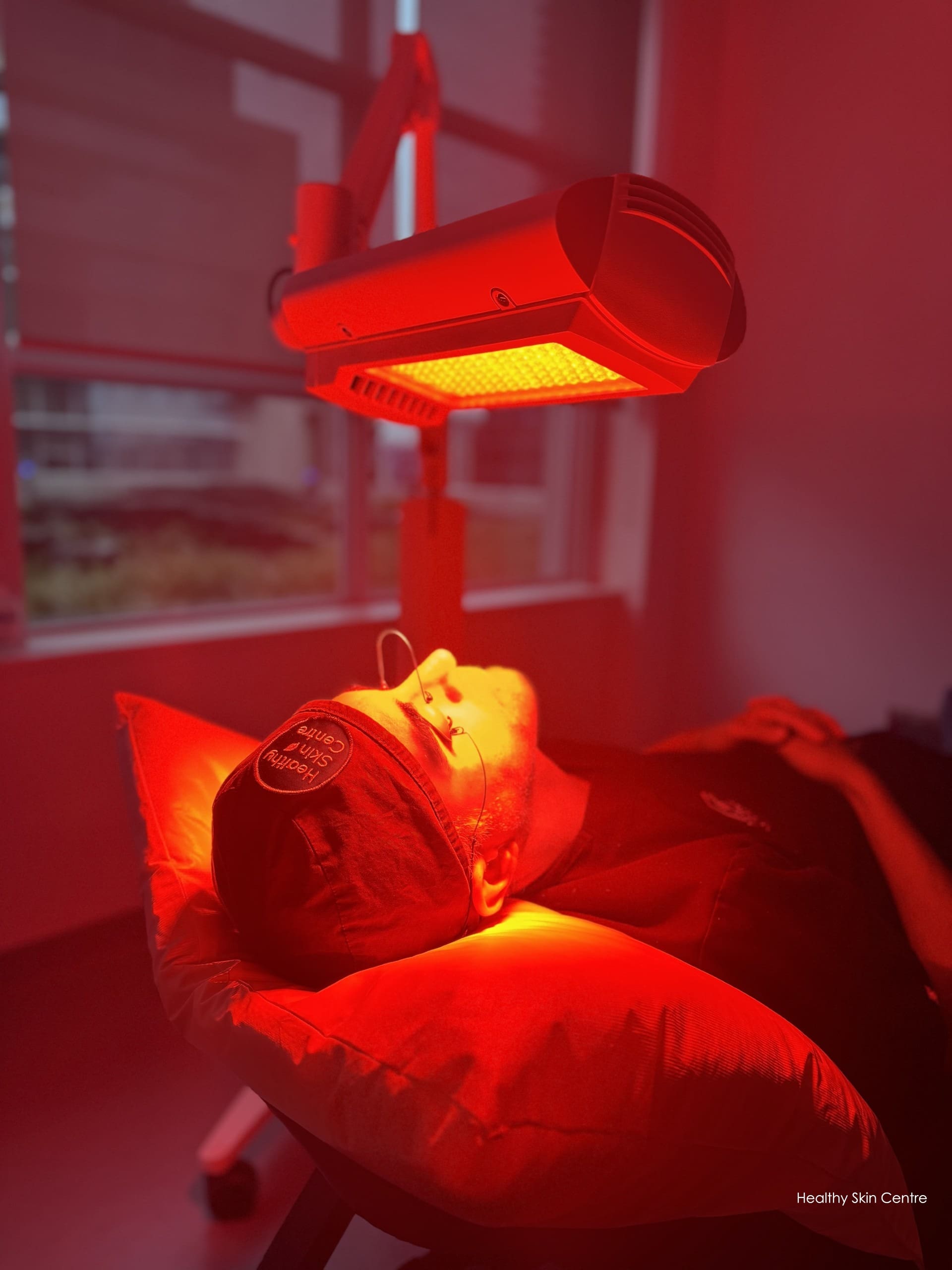
If you spend your summers outdoors, have a history of sunburns, or simply love a daily walk in the sunshine, there’s a good chance your skin has collected more UV damage than you realize. While sunscreen is a must, there’s a powerful, non-invasive medical treatment now gaining momentum across Canada for preventing skin cancer before it forms—and it’s quietly changing the lives of patients at Healthy Skin Centre in New Westminster, BC.
It’s called Photodynamic Therapy, or PDT, and according to Dr. Eiman Nasseri—a double board-certified dermatologist, Mohs surgeon, and one of Canada’s leading PDT experts—it’s one of the most exciting tools we have today for intercepting precancerous cells. “Cancerous and precancerous cells have a higher metabolism than healthy ones,” explains Dr. Nasseri. “PDT selectively targets those abnormal cells, destroys them, and leaves healthy tissue untouched.”
For someone who treats skin cancer daily, prevention isn’t just a priority—it’s a passion. And PDT is one of the few treatments that works at the cellular level to stop trouble before it begins.
A Globally Trusted Treatment, Now Gaining Ground in Canada
PDT has long been used worldwide to treat actinic keratoses (precancerous lesions) and early superficial basal cell carcinomas. In Canada, it’s still offered in select centres—and Healthy Skin Centre is one of the few clinics specializing in skin-cancer-prevention PDT. That’s no coincidence: Dr. Nasseri attends the international PDT conference annually and lectures globally to educate physicians and patients about this precise, elegant therapy.
Rather than freezing or surgically cutting out lesions one by one, PDT treats the entire field of damaged skin—making it especially appealing for people with widespread sun damage on their face, scalp, chest, arms or hands.
“It’s extremely effective, safe for all skin types, and leaves no scarring,” says Dr. Nasseri. “And unlike at-home topical treatments that require three to six weeks of use, PDT is completed in a single 3-to-4-hour appointment under medical supervision.”
How PDT Works
The science behind PDT sounds high-tech—but the patient experience is surprisingly simple. After cleansing the skin, a photosensitizing cream called Metvix is applied. Over one to three hours, Metvix is absorbed preferentially into pre-cancerous and cancerous cells. Then the treated skin is illuminated with a calibrated red light. That’s when the magic happens.
“When red light hits the Metvix, it releases energy inside the abnormal cells, causing them to rupture and die,” explains Dr. Nasseri. “Healthy cells absorb almost no Metvix—so they remain completely unharmed.”
The light exposure itself lasts only about eight minutes. Some patients feel warmth, tingling or mild stinging; others feel very little. Nurses remain with patients throughout the process and use cooling sprays to relieve heat.
What Patients Can Expect
After treatment, expect a sunburn-like redness for 48 hours, followed by crusting and peeling over five to ten days. “It’s essentially your sun damage falling off,” says Dr. Nasseri. The end result: smoother, brighter, healthier skin—and importantly, a significantly lower risk of developing skin cancer in the treated region.
PDT is especially beneficial if you regularly spend time outdoors (hello, golfers, skiers, hikers and gardeners), have a history of tanning bed use, or have had previous skin cancers. It’s also an option for acne sufferers, as PDT can shrink overactive oil glands and target acne-causing bacteria.
How PDT Compares to Other Treatments
Traditional treatments for actinic keratoses include cryotherapy, topical chemotherapy creams like 5-FU, and imiquimod. Surgical excision is standard for many skin cancers. PDT stands out because there’s no scarring, no prolonged downtime, and no at-home application risks.
“Many patients prefer PDT because it’s supervised, fast and extremely effective,” says Dr. Nasseri. “And because it treats the entire area—not just single lesions—it helps prevent new spots from forming.”
How Often Should You Get PDT?
For significant sun damage, Dr. Nasseri recommends treatments every three months until the skin has cleared, then annual maintenance. For early basal cell carcinomas, studies show the best results with a second session one week after the first, followed by another at three months.
Is PDT Covered?
Coverage varies across Canada. Some provincial plans cover PDT entirely; others offer partial reimbursement. Many private insurers cover the Metvix drug cost. Healthy Skin Centre helps patients maximize available coverage.
A PDT Promo
Healthy Skin Centre is offering a limited-time promotion: readers who mention the title of this article when booking will receive $50 off the Red Light portion of their Photodynamic Therapy session.
The offer is valid December 1, 2025 to January 5, 2026. To book, call 604-553-7546.
The Future of PDT
The field is advancing quickly. Dr. Nasseri is excited about new light sources—including sunlight-based PDT and combined treatments with cosmetic lasers—to make sessions even more effective and more comfortable.
Ultimately, he says, PDT’s biggest promise is empowerment. “My goal is to help people feel more confident and in control of their skin health,” he shares. “Skin cancer is preventable, and PDT is one of the most powerful tools we have to make that a reality.”
For anyone with a history of sun exposure (which is most of us), PDT may be the preventive upgrade your skin has been waiting for. —Noa Nichol
share:

December 2nd, 2025 at 10:14 pm
Wow very cool! I am going to find out if it’s available in Ontario! Thanks for sharing ♥️ @trishap67
December 6th, 2025 at 7:17 am
Skin health does not rely on medical treatment alone: daily habits, natural skin care and gentle maintenance also matter. That makes me think of brands like Jacana – they emphasise plant-based, sun-nurtured botanicals for skin hydration and after-sun care. While PDT might handle precancerous cells under medical supervision, products from companies such as Jacana could support skin recovery, hydration and resilience in everyday life https://jacana.life
December 10th, 2025 at 12:18 am
Thank you for the information in this article. Excellent work!
March 25th, 2026 at 4:23 pm
Přeji pěkný večer ze Svitav! Našel jsem tuhle stránku náhodou při vyhledávání her pro svůj telefon. Hledal jsem něco, co by mi nabídlo napětí i šanci na zisk bez jakýchkoliv podrazů na hráče. Platforma https://spino-gambinos.cz splnila všechna má očekávání na jedničku. Moje nedávná výhra mi udělala radost a potvrdila, že i v online světě se dá trefit slušný balík peněz. Jsem s jejich službami spokojený a doporučím je dál přátelům.