
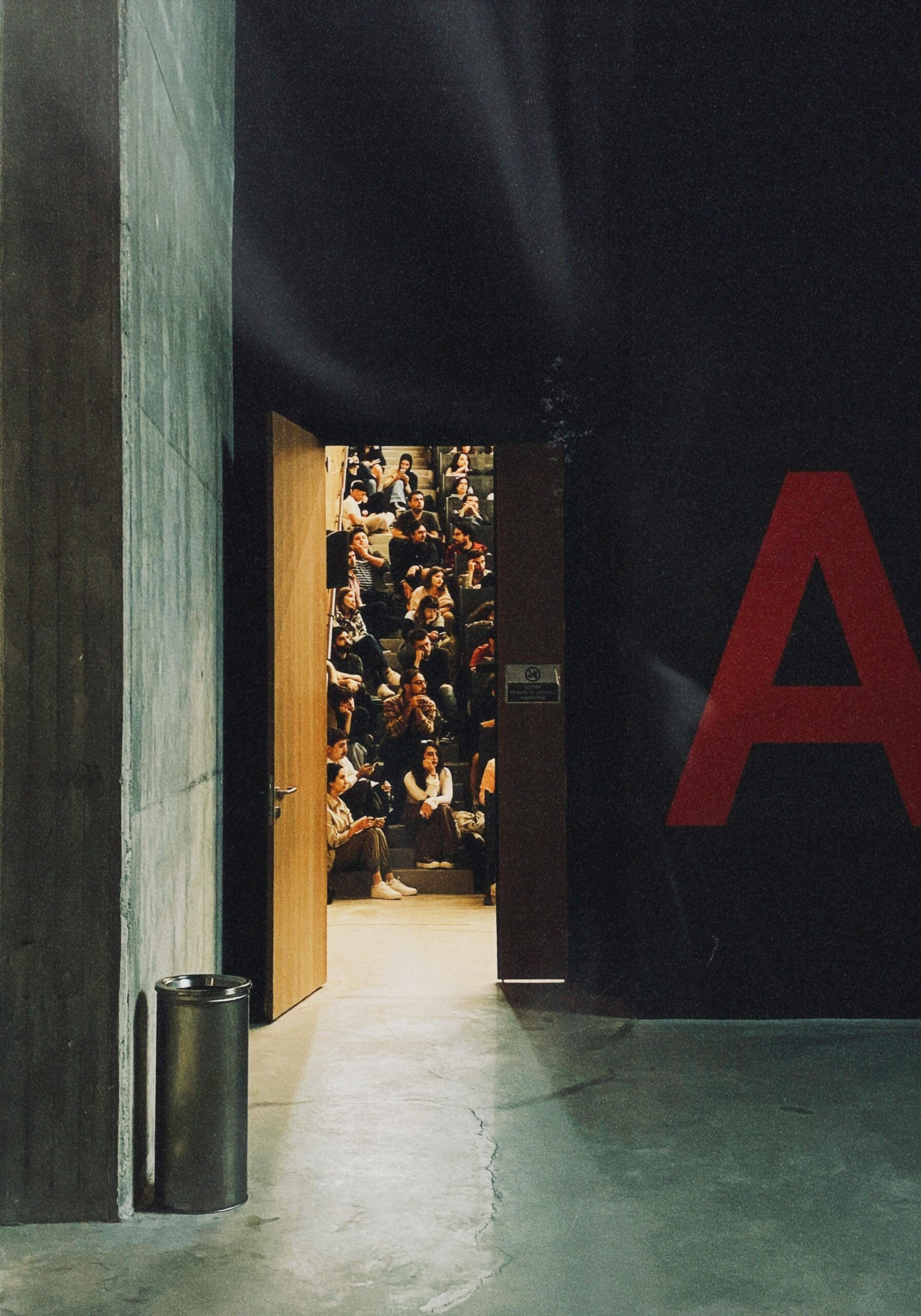
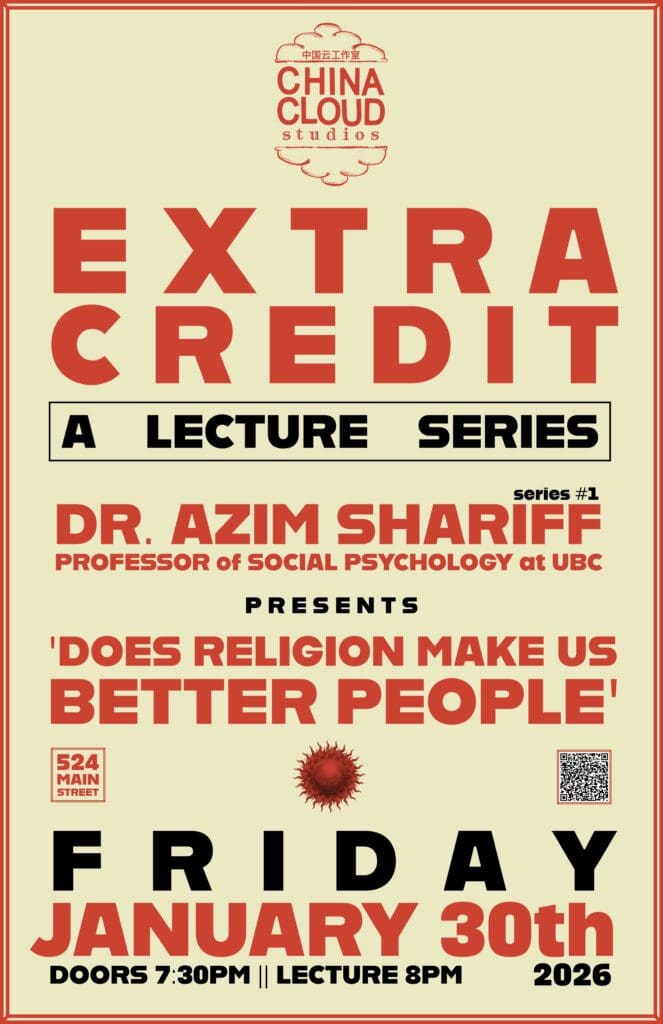
Forget passive scrolling and stiff lecture halls—EXTRA CREDIT, a new lecture series from China Cloud Studios, is bringing big ideas back into the room. Designed as a warmer, more social take on a TED Talk, the series invites curious Vancouverites to gather in person for thought-provoking talks, real conversation, and a drink in hand. We sat down with organizer Jennifer Bojm to talk about why now felt like the right moment to launch EXTRA CREDIT, what makes it different from traditional lectures, and how its first talk—UBC professor Dr. Azim Shariff’s deep dive into Does Religion Make Us Better People?—sets the tone for a new kind of intellectual night out. —Noa Nichol
Extra Credit is described as a warmer, more fun take on a TED talk. What was missing from traditional lectures or online talks that inspired you to create something different?
We have such a bright, curious and creative community around us who love to learn. If you aren’t in school at the moment it can be hard to access a lot of educational content that isn’t found online in soundbites. Options for nightlife don’t often include an engaging learning element. We created Extra Credit because we felt that merging a fun environment with an educational component would bring people something unique.
Why did it feel important to centre this series around in-person learning and dialogue, rather than another digital or streamed experience?
So many people access information almost entirely online. Online learning can become a lonely experience that gets stuck in algorithms and echo-chambers which create such polarized viewpoints, anxiety and conflict. We want to bring people together to mingle with their community, converse in person, look one another in the eye, agree, disagree, laugh, share, enrich and enlighten each others lives. I am a Clinical Counsellor and can say with certainty that people need more access to engaging in person environments. We are social beings. Our mental health thrives from belonging and connection that goes well beyond online chatter.
China Cloud Studios has a very particular atmosphere—intimate, creative, and welcoming. How does the space itself shape the way people learn, connect, and engage during these lectures?
China Cloud Studios is the PERFECT environment to host this event. It feels like being in a casual living room with friends. It is warm, with soft lighting and comfy seating. It also hosts a lot of music and comedy events. You can feel the levity and creative history in there. If the walls of China Cloud Studios could talk, they would say, ‘come together, be creative, learn and love one another’ They might actually sing that! Colin Cowan – the founder and owner of this cultural staple (also my husband) has worked extremely hard to keep China Cloud studios running with the goal of continuing to bring community together. We are so fortunate to have such a venue in Vancouver and there is no better place to host this event.
The first lecture tackles a big, provocative question: “Does religion make us better people?” Why did you want to launch the series with a topic that invites curiosity, debate, and reflection?
As a young student, I studied ‘Religions, Literature and the Arts’ I was also studying Psychology which is how I met Azim – who is giving the first lecture. I was a research assistant for one of his studies. We are teaming up to host Extra Credit ongoing and build a growing roster of interesting lectures from a variety of disciplines. I was always drawn to his research content which among many other things, looks at how religion shapes our morality. Today’s changing landscape around religion as well as geopolitical events have stirred up this subject in a lot of people. This is exactly the kind of timely and important—but also challenging—topic that we want to feature here. People often have strong feelings about religion, and we want to show right off the bat, how this series can give people a venue to have open and positive discussion about those types of issues.
You’ve invited academics from a wide range of disciplines. What excites you most about bringing scholarly research into a more social, relaxed environment?
There are a few academic learning events that the public can access if you’re not currently a student. However they are held in more formal environments that don’t seem to draw in people who either would want to attend or could really benefit from attending. I think people want to engage in a deeper way and on interesting subjects but there aren’t a lot of options that split the difference between classic academia and loud night club or restaurant. China Cloud Studios has always been a listening venue. We want people to come, listen to the speaker and then talk and listen to each other.
Many people are craving community and depth after years of scrolling soundbites. What kind of audience experience are you hoping Extra Credit creates—emotionally or intellectually?
We want to build community. We want to be a part of fostering offline communication that is discourse based. We want people to come to Extra Credit and feel a weight come off their shoulders where they can feel a sense of curiosity and belonging. Seeing as China Cloud Studios is also a creative arts hub, we have talked about inviting musical guests in the future as well, so the event is interdisciplinary and even more enriching.
How do you envision the “after” part of the lecture—the mingling, conversations, drinks—playing a role in the overall learning experience?
We will be holding the space open following the lecture. We will be playing great music, inviting people to stay, socialize, ask questions, and mingle with the speaker. We want people to make a night of it, have some snacks and refreshments and settle into the environment.
Looking ahead, what do you hope Extra Credit becomes for Vancouver’s cultural and intellectual scene, and how do you see it evolving over time?
We hope to build up the reputation of Extra Credit as one of the best things to do in Vancouver. Hopefully people come, bring friends, make friends, make plans to collaborate and bring more positive connection into the world. We have spoken about looking into getting some grants to help document and archive the events and maybe help us to fly in speakers if they don’t live in Vancouver. We may also look at doing some larger events if we can build up a larger audience.
share:

January 31st, 2026 at 1:59 am
Kamu tau tidak IDH itu apa
May 8th, 2026 at 2:30 am
The part that lingered for me was the way you handled “Why did it feel important to centre this series around”. Pieces on this subject often push toward certainty too early, and this one did not.