
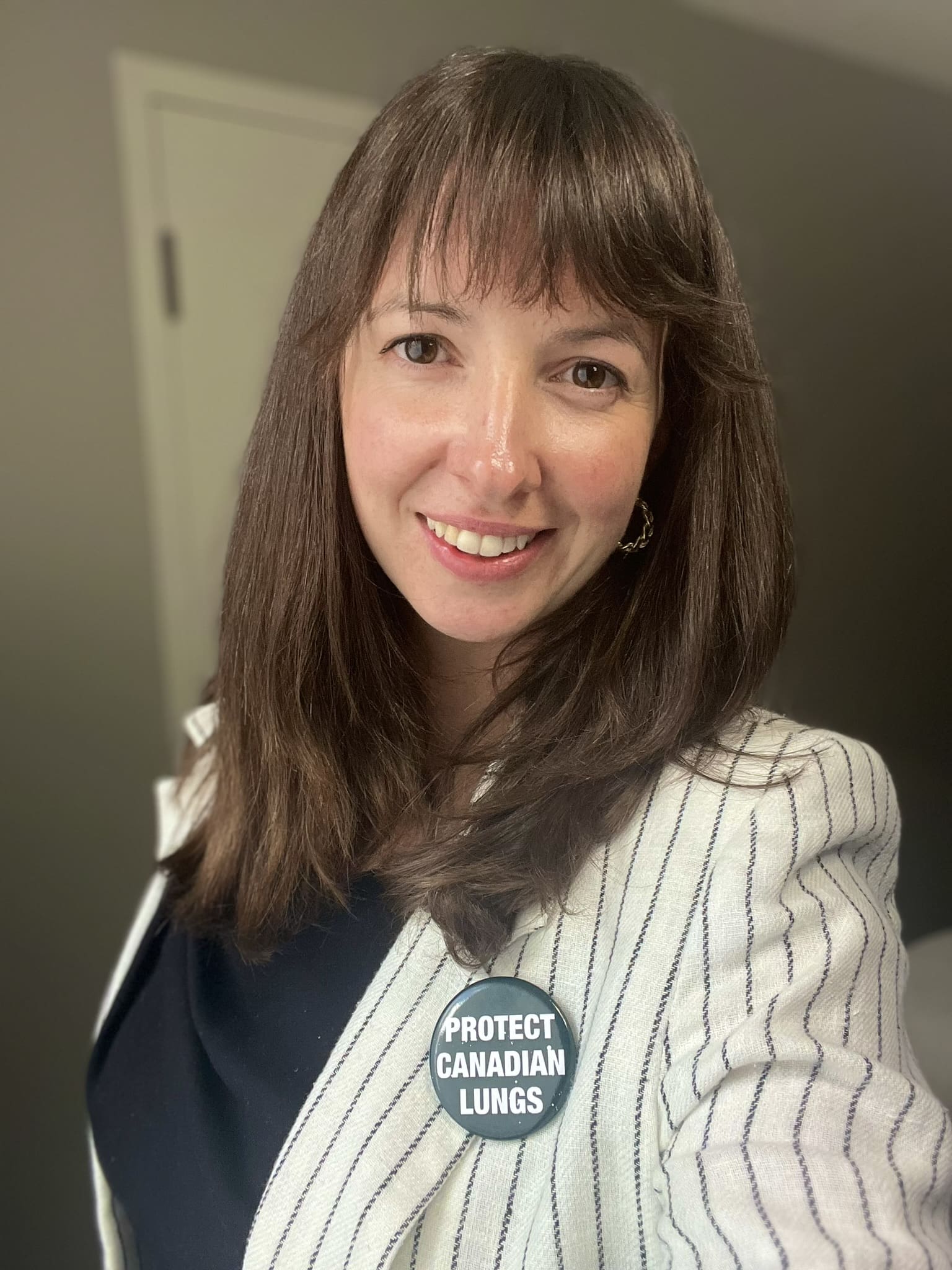
A Q&A with Katie Hulan on Rewriting the Future of Lung Cancer Care
A rare diagnosis can feel isolating—but for Katie Hulan (ALK Positive Canada) it became a catalyst for action. Recognized nationally for her advocacy work, Katie, one of the Pfizer Oncology RFP Winners, is helping reshape how Canadians with rare lung cancers access information, treatment, and support. In this conversation, she opens up about her journey from diagnosis to leadership, the urgent need for patient-focused research, and what meaningful innovation in cancer care really looks like. —Noa Nichol

Can you take us back to the moment of your diagnosis—what do you remember most, and how did it change the way you looked at your life moving forward?
At the time, I was 33 years old, working full-time and enjoying life in my early 30s. Aside from a persistent cough that was worsening by the day, I wasn’t slowing down. What I remember most about my diagnosis is the whiplash from going from an ordinary workday to rushing to the emergency room to find out why my test results were so bizarre. Over the course of 2 days, I was told I had stage 4 lung cancer with a prognosis of months to live. It was devastating, frightening and surreal. Over the next few days it felt like life was passing by me, and I had hit the brakes. Over time, I regained confidence thanks to a good treatment plan, and decided to focus solely on getting better. Now I advocate to ensure people are aware of lung cancer signs, that treatments are accessible and that they understand what living with stage 4 lung cancer can look like.
Living with stage 4 ALK-positive lung cancer is something many people struggle to understand—what do you wish the public knew about what daily life really looks like for you?
I’ve had side effects over time based on the drug therapies and radiation I have had over time. Thankfully, I have been able to manage this well with my health teams. For the most part, I live life as if I didn’t have a diagnosis at all. I continue to do the things I love and explore new things to do all the time. Since my diagnosis, I have had so many incredible experiences: from being at important milestones of friends and family, taking on new roles in my career, volunteering to travelling and getting married and building a life that I’m proud of. We even moved across the country from Toronto to Victoria, BC, a dream we both had before my diagnosis.
At what point did you feel a shift from being “just” a patient to becoming an advocate, and what sparked that sense of responsibility to speak up?
Unfortunately, not everyone is as lucky as I’ve been. Access to treatments, clinical trials, and testing are not always available to everyone, especially outside major cities. Clinical trials are often hard to find or access, and financial coverage of targeted therapies is not guaranteed. I’ve met with and read the stories of many Canadians with the same diagnosis as me who have such a hard time getting the right care, timely care or even just navigating systems. All of these factors made me reflect, learn more and become an advocate. I want to ensure that every Canadian can access the right care at the right time. It saved my life and continues to save it each and every day. Knowing that if it was possible for me, it’s possible for everyone. That’s why I advocate. In 2024, a few patients came together with a desire to do something more. In 2025, we formed ALK Positive Canada to build more community and research opportunities, and to advocate and educate.
What are some of the biggest gaps you’ve personally experienced in care or education for people diagnosed with rare cancers like ALK+ mNSCLC?
Since every person is different, their experience will be different. For me, knowing what options there were for family planning, or how to deal with the side effects I am managing, how to advocate for myself and have conversations with my health teams – these were all daunting topics and still can be. I still learn from others; whether from patients or other oncologists. As you live with a disease, your context changes, your needs change, your therapy and the impacts of that can change. We have to continuously learn, but finding the right ways is difficult. You only have so much time with your health care team.
How has connecting with other ALK+ patients through advocacy shaped your own sense of strength, resilience, and hope?
Connecting with other ALK+ patients has grounded me and given me more reasons to advocate. As part of my role with ALK Positive Canada, I’ve connected with many other caregivers and people living with the disease. Their resiliency, questions and needs motivate me. They’ve supported me as I’ve navigated this advocacy experience by offering resources, connections, and answers when I’ve needed them. I learn from them every day. Watching people in our community live their lives on their own terms, despite everything, reminds me what’s possible and keeps me going.
Receiving support through the Pfizer Canada grant is a major milestone—what does this funding make possible that wasn’t before, and why does that matter so deeply to you?
This grant now allows ALK Positive Canada to build highly valuable and patient-centric information for Canadians from coast to coast. It funds a national patient education initiative designed specifically for Canadians diagnosed with ALK-positive nonsmall cell lung cancer. We’ll be able to deliver plain language education to help patients understand treatment sequencing, better understand and manage side effects, and communicate more confidently with their oncology teams. That means Canada-wide education sessions (like having an expert oncologist right in your living room), practical side effect guides patients can actually use in day-to-day life, real-life patient stories, and supportive peer groups so no one has to try to navigate this diagnosis alone or feel like they’re the only one going through it.
Cancer can be incredibly isolating—what role has community played in helping you navigate the hardest moments of your journey?
In the beginning, community meant the people closest to me. My husband, family, and friends were the ones who helped me when I was still reeling from a stage 4 diagnosis and a prognosis measured in months. They still help me immeasurably today. As time went on, finding other people living with ALK-positive lung cancer changed everything again. There’s a special kind of relief in talking to someone who doesn’t need you to explain the details. They already understand scans, side effects, etc. Connecting with others has given me language, understanding, and perspective for conversations with my health team, and it has reminded me that there are many different ways to live fully with this disease.
How do you balance living in the present with a diagnosis that carries so much uncertainty about the future?
For me, it’s a constant, imperfect practice of holding both things at once: acknowledging the uncertainty and life-threatening disease as it is, but choosing joy, adventure, and choosing to build a meaningful life with it. I have had to work at length on my mental health on this. It’s been difficult. But I am getting better at it. I’ve prioritised my health over everything else. This still gets challenged by the busyness of life, but health means life.
On days when advocacy work feels heavy, what keeps you grounded and reminds you why this work is worth continuing?
When advocacy feels overwhelming, I step back: I take a break, meditate, or do something that brings me back to myself. I also let myself sit with the hard feelings and understand them rather than pushing them away. That honesty reminds me that these emotions exist because this work, and the people it impacts, matter deeply to me. What ultimately grounds me is remembering the people like other advocates, oncologists, and patients who’ve said, “never give up, something will always work.” I’ve seen treatments change lives, including my own, and I think about the patients who are just being diagnosed or still fighting for care. Knowing that even small wins can change someone’s entire story is what keeps me going.
As we approach World Cancer Day, what message would you most want newly diagnosed patients—or their loved ones—to hear from someone who truly understands?
If you’re newly diagnosed or love someone who is, here’s what I’d want you to hold onto: it’s okay to be scared and overwhelmed. It’s okay to feel lost at first. But you don’t have to navigate this alone or in the dark. Reach out to ALK Positive Canada or its community, ask every question, push for the best possible care and connect with others who have walked this path. There are people and resources ready to meet you exactly where you are, and to help turn this tough diagnosis into a different, meaningful life that is still very much worth planning for.
share:

Be the first to comment