
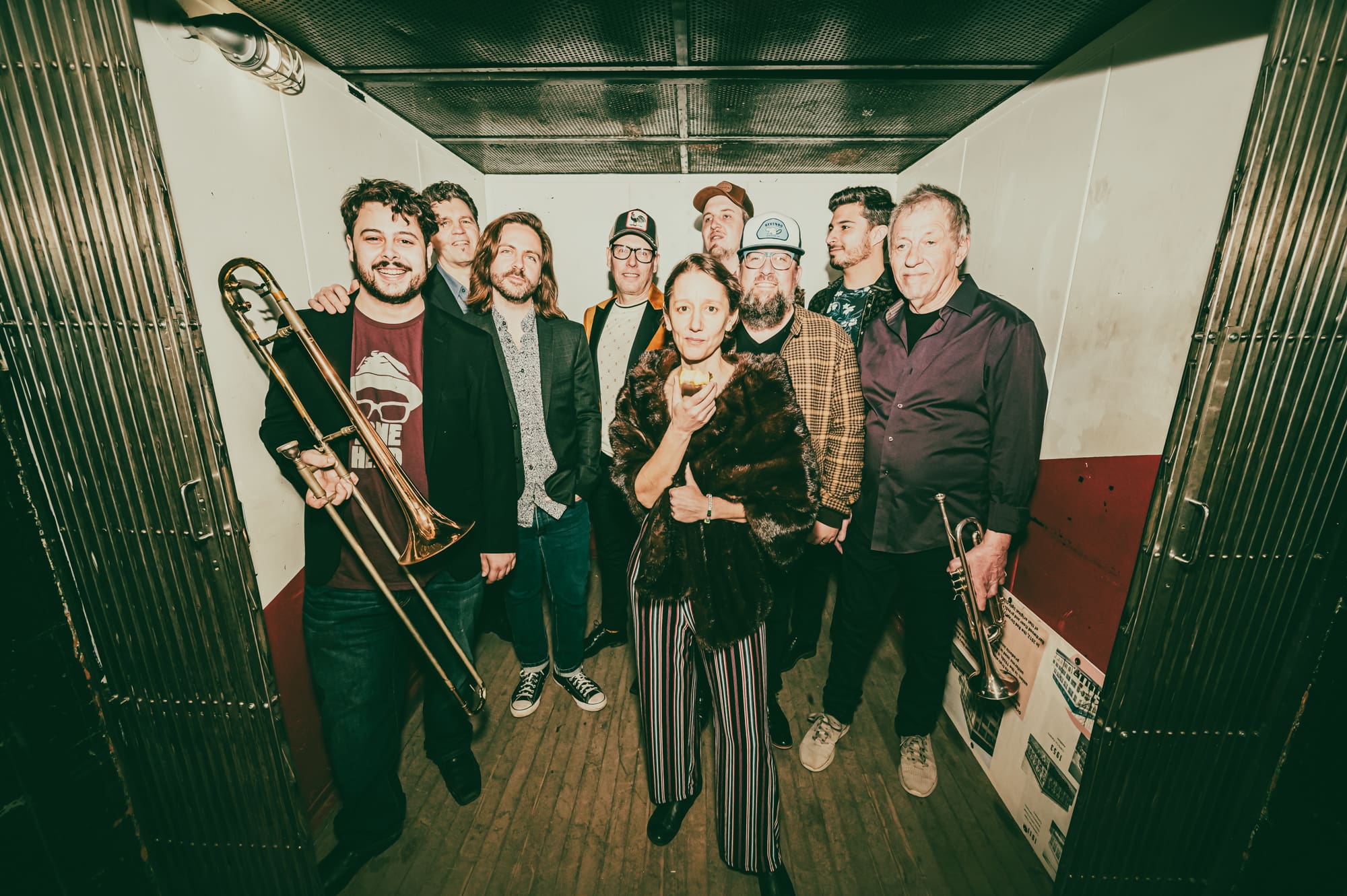
In a digital era of bedroom pop and solo DJs, Edmonton’s Secondhand Dreamcar is doing the impossible: bringing back the big-band “revue” and winning big. Ahead of the 2026 JUNO Awards, this nine-piece collective has pulled off the ultimate industry heist as the only fully independent, first-time nominee in the Blues Album of the Year category for their explosive debut, Answer the Call.
With a horn section that could wake the dead and the powerhouse vocals of Dana Wylie, this group didn’t need a major label to find their groove. Instead, they built their momentum the old-fashioned way—through a legendary nine-month club residency, grassroots touring, and a sound so soulful it’s been called the most exciting thing to come out of Alberta since k.d. lang. We caught up with the band to talk about the “independent” hustle, the magic of a nine-person ensemble, and what it feels like to “Answer the Call” of the national stage. —Noa Nichol
You are heading into the JUNO Awards as the only fully independent and first-time nominee in the Blues Album of the Year category. How does it feel to “Answer the Call” as a grassroots collective standing alongside major label acts?
It feels wonderful, and I suppose it’s quite validating, because as a fully independent act the main resource we have under us – fueling us and driving us – is the quality of our work. So to have that work recognized in this way is very heartening. Particularly because we truly are a collective; collaboration is at the heart of who we are as a band and how we work. Also, I’d be remiss not to note that despite not having formal industry affiliation via record labels, etc., we do have some generous and knowledgeable colleagues in the industry who continue to be a huge help to us.
At a time when the industry is leaning toward smaller, digitally driven acts, you’ve hit the scene as a massive nine-piece ensemble. What is the secret to managing the logistics and the creative energy of such a powerhouse “superband”?
I wish there was a secret! But really, it’s a journey, and we’re finding our way as we go. We’re fortunate to have a real complement of strengths and skill-sets in the band; we’ve all been working in music for a long time, and we’ve all gotten to where we are now by very different paths, and have acquired different skills and perspectives along the way. Particular credit goes to our bass player Harry Gregg for managing the big picture of the band as a business, but we all do our bit to make sure all the to-do lists are getting done and not too many balls are being dropped. Unsurprisingly, perhaps, the music is the easy part!
Your band “cut its teeth” during a nine-month residency at Edmonton’s legendary Blues on Whyte. How did that consistent time on stage together help forge the deep-pocket grooves and “Memphis-style” horn textures found on your debut album?
That consistent stage time in the early days of the band’s formation was everything. Its significance can’t be overstated. Nothing can replace it in terms of forming that deep pocket, and the chemistry.
Dana Wylie, your vocals have been described as having the “soulful authority” of Susan Tedeschi. How do you balance that raw grit and vulnerability when leading a three-piece horn line and such a tight rhythm section?
I always feel as a singer that I can let the songs and the band carry me. It’s a gift as a vocalist to have such power (and tightness) under you. It means I can follow my own instincts in the moment and the band will be right there with me. There’s a dynamism at play that both makes space for the quietest, most delicate moments, and forms a wave under me when it’s time to let ‘er rip.
Journalist Peter North called the band the most exciting thing to come out of Edmonton since k.d. lang and the Reclines. Does that kind of hometown comparison add pressure, or does it fuel the fire for your live performances?
No, it doesn’t add pressure at all! We just take it as a wonderful compliment. And it’s good too to remember our city’s musical legacy. It’s always been a great music town.
Your debut album reached #6 on CKUA’s Top 100 Albums of 2024. As an independent group, how vital has that national radio support been in building momentum outside of the traditional label system?
So vital. Indispensable. We truly couldn’t be more grateful for it.
Your songs often explore themes of resilience and personal reckoning. Was there a specific moment during your grassroots touring where you felt the audience truly connect with the “relatable storytelling” of this record?
I don’t know if I can remember a specific moment, but when those moments happen they’re unmistakable. Most of the songs at our live shows are pretty up-tempo and get people grooving, but there’s a different kind of energy that can permeate a room on the slower, sparser songs where the lyrics really come through. When I feel that – like they’re really getting it, connecting with the “message” (for lack of a better term) – it almost feels like the air is crackling a little bit. Like the connection creates its own extra presence, like a weather system.
With a new album planned for Fall 2026, how has this whirlwind JUNO nomination and your recent festival circuits influenced the sound of your next project?
Our goal with Answer the Call was to capture the spirit of our live sound. And we achieved it by recording the vast majority of the thing live off the floor. We’ve been so thrilled with how well that album has been received, and it has perhaps reinforced our conviction that we’re on to something in terms of our way of working. We just finished recording our second album last month, and we employed exactly the same production approach. The difference is we’re a better, tighter unit than we were before, thanks to all of the shows we played last year, and we’ve written a stronger batch of songs because we’re tighter as a songwriting unit. Our hope, and our belief, is that the next record, which will be out in the fall, will have the same spirit as Answer the Call, but will be deeper, richer, and stronger.
share:

Be the first to comment