
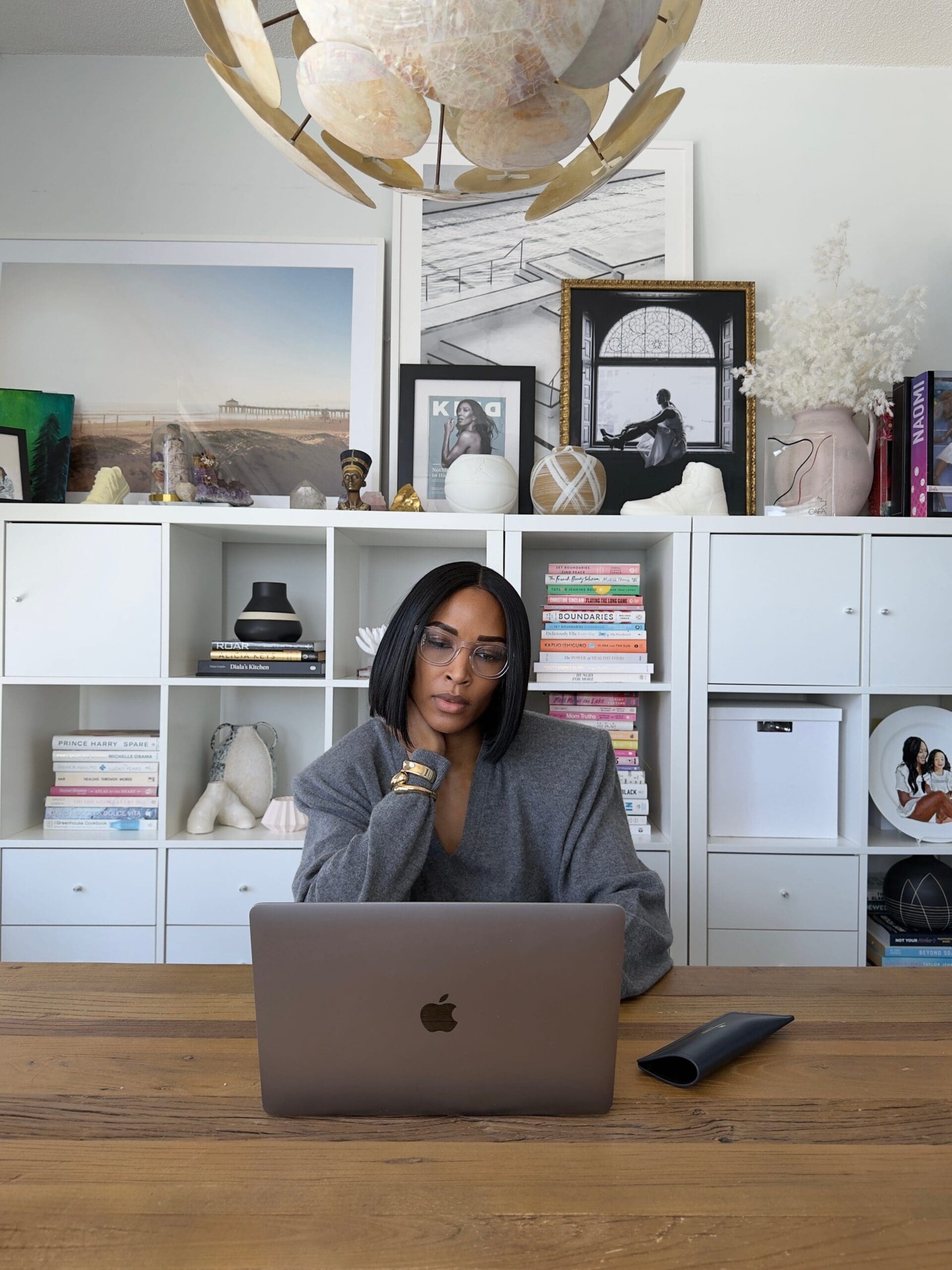
Recently, Allyson Grant, a forty-something Vancouver-based artist and actor, noticed changes in her vision. “In restaurants I did the thing that I always made fun of all my older friends for doing. Pulling and pushing the menu closer. And then finally getting out my light.”
There were other indications. “Everything was really blurry in the morning,” she says. “I do a gratitude journal in the morning, and I couldn’t read the small print to see the prompts.” She booked an appointment with her optometrist, and was prescribed reading glasses.
There’s a name for this natural, age-related loss of up-close focus: presbyopia. It’s a phenomenon that you’ve either experienced—or will eventually. In Greek, the word means “old eye.”
“It’s the result of the lens inside the eye losing flexibility over time,” says optometrist Dr. Natalia Nowakowska. “That lens works like a zoom lens.” The lenses in our eyes are more flexible in our youth, she explains, allowing us to focus on nearby objects.
The shift from being able to read a menu in low light to having to lean dangerously close to the ambience-providing candle may come on suddenly—or at least feel that way. Plus, if you’re female and of a certain age, there may be other factors besides age affecting your vision. “During perimenopause, as well as menopause, drops in estrogen can cause blurred vision from dry eye and increased risk to certain eye conditions,” says Dr. Nowakowska. “Glaucoma, even cataracts.”
Toronto-based content creator Sasha Exeter recently published a Substack article about her vision that she describes changing from one day to the next. “One night I went to bed seeing my phone perfectly,” she writes. “The next morning? My text messages looked like they were written in a light fog.”
“It honestly felt like a betrayal I didn’t see coming,” Exeter, in an interview with VITA, adds. “One day my body was doing exactly what I expected of it and the next—it shifted the rules without asking for permission. It was like a line I didn’t even know I was approaching, but then it was suddenly behind me. And I think that part rattled me the most. The vision is just one part of it. There was also a feeling of losing control.”
But, she continues, “Here’s what I’ve come to understand—and what I’d say to any woman hitting that same invisible line: first, this isn’t a failure. It’s not you ‘losing it.’ It’s your body doing exactly what it’s designed to do, even if the timing feels wildly inconvenient. Second, don’t suffer in silence or power through it like it’s something to endure. We’ve unfortunately been conditioned to normalize discomfort, especially as women in our 40s. Addressing it head-on means booking the eye exam, getting the glasses or simply saying out loud, ‘OK, things are changing.’ Because the truth is, this won’t be the last shift. But it doesn’t have to be a scary one—it can be a clarifying one.”
Indeed, the next logical step is reading glasses, which, let’s be honest, come with their own emotional baggage. Exeter says she will embrace this necessary new accessory: “Most people in my industry assume I am younger than I am, so wearing readers felt like handing over a birth certificate and announcing my age. But I have come to realize that there’s a level of clarity, discernment and self-trust I have now that I didn’t have in my 20s. The glasses just happen to be the most visible symbol of that. So instead of seeing them as something that gives me away, I see them as just something that grounds me in who I am now.”
For Grant, appearance, and her apparent age, are important in her line of work. But she says she doesn’t mind wearing readers. ”Glasses are super chic and fun.” However, she concedes that reading glasses in particular can betray a person’s age. “I have readers, which certainly are an indication of usually mid- to late-40s or later.” Without them, she “can usually squeeze by as a little younger than that.”
Both women’s sentiments are exactly what Montreal-based eyeglass company French Kiwis built their brand on. Gad Benchimol, co-founder and CEO, supplied reading glasses to pharmacies, but business faltered during the pandemic due to “no try-on” policies. Then an idea formed: what about reading glasses that look good, like a designer pair, but don’t have the same price tag? The success of their stylish readers have propelled them into sunglasses and other frames, but reading glasses are their base.
Benchimol imagines the French Kiwis customer on a date or in a business meeting, pulling out a pair of reading glasses to read the menu or contract in front of them. In that scenario, Benchimol asks, would you rather pull out a cheap pair of readers or “a pair that the person in front of you is going to be like, ‘Oh my god, those are amazing glasses.’”
That Benchimol’s imagined customer is out on a date or at a business meeting—not straining to see their cross-stitch—reflects a shifting sentiment about aging. At one time, getting older meant creakiness and obsolescence. Today, a person’s vitality enjoys a dramatically increased lifespan.
“We are very much still in our prime, and we are still very much into fashion and self-expression,” says Gaelle Margulies, the marketing manager at French Kiwis. “And so for us, it was easy, in a sense, to identify the type of product that we wanted to create. Because we felt like we were creating it for ourselves.”
Whether you wear reading glasses or not, there are a few things you can do to support eye health. “Diet is important. Lutein, specifically, which we could get from leafy green spinach helps with maintaining macular health. Omega-3s help with dry eye. Staying hydrated is always important,” says Dr. Nowakowska. But perhaps even more important: UV protection and regular eye exams.
Indeed, despite her protestations, Exeter came around to reading glasses. “What I thought would feel like a concession … started to feel like accessorizing,” she writes. “There’s something very powerful about owning the phase you’re in instead of pretending you’re not in it.”
And she adds, “I approach readers the same way I approach any accessory—they need shape, intention and a point of view,” she adds. “I’m drawn to frames that feel architectural and refined, not invisible. Colour matters, too; creamy neutrals, tortoiseshell or clear tones that work with my wardrobe. And styling is key—glasses should be part of the look from the start, so everything from the lip to the earrings feels cohesive and chosen.”
Grant has similar feelings of acceptance. “I’m an artist. I use my eyes for everything. I’m very visual.” Plus, wearing reading glasses help protect her eyes from the progression of vision loss. “I’m not devastated about it, but there’s an awareness of time passing,” she says.
How very grown up. —Jill Von Sprecken
share:

April 27th, 2026 at 3:34 am
Really helpful. Much to learn from the post. Thanks a lot for sharing amazing content.