

Joe DeNicholas thought he could solve any problem through hard work, intelligence, and persistence—until a catastrophic failure at work sent him into a crisis he couldn’t engineer his way out of. What began with a smoking microchip evolved into a decades-long journey through burnout, Buddhist psychology, neuroscience, and healing. Today, the former tech engineer turned therapist and contemplative teacher helps others move beyond coping and toward genuine wellbeing. We sat down with DeNicholas to discuss the hidden suffering beneath high achievement, the limits of optimization culture, and what it really takes to cultivate peace in a world that never seems to slow down. —Noa Nichol
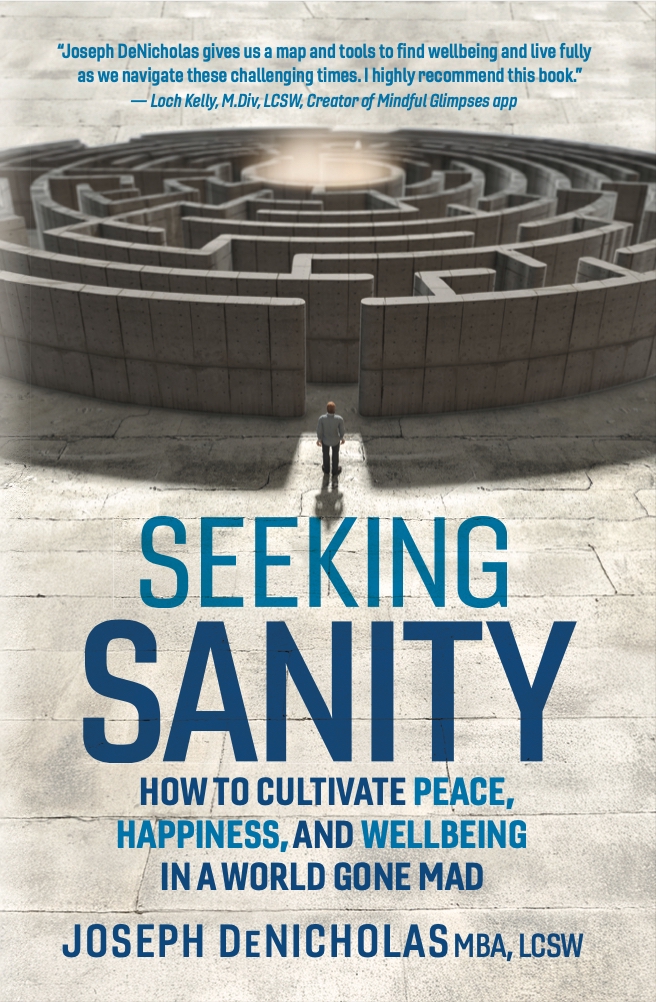
Your journey began with a spectacular failure in the tech world. Looking back now, do you think suffering sometimes arrives as a form of wisdom before we’re ready to recognize it as such?
I couldn’t have said it any better! There is always something to learn from our suffering – about ourselves, others, or life in general. This question reminded me of some advice a teacher of mine gave once: In this life, you get the ride you need, not the one you want.
In a culture that celebrates achievement, productivity, and optimization, why do so many high performers still feel anxious, disconnected, or unfulfilled once they’ve reached the goals they thought would make them happy?
Because part of the motivation that drove their success was filling a hole in their self-concept – be that conscious or unconscious to them (this darker motivation loves to hide behind more positive and healthy motivations). As an engineer, I can say that problems need to be solved at their root, otherwise we are just applying Band-Aids to them. No amount of external achievement or affirmation will be enough to fill an internal hole in one’s heart.
You write about healing the root causes of suffering rather than simply managing symptoms. How can someone tell the difference between true healing and becoming very skilled at coping?
While it is vital to cope – and best to cope in healthy rather than unhealthy ways – coping never ends because there is no underlying resolution occurring. If someone can dedicate even 15 minutes a day to the underlying causes of their suffering, the amount of coping needed is very likely to decrease (slowly) over time. Improvement will be measured in months or even years, so some patience, persistence, and diligence will be needed. But the important point is that change is coming. That’s how we know we are healing – we increasingly make life less complicated and afflicted, and we react better and more compassionately when things don’t go our way.
Buddhist psychology teaches that much of our suffering comes not from life itself, but from our relationship to it. What are some of the most common ways modern people unknowingly create additional suffering for themselves?
That’s quite a question for a short-form interview! As a general statement, I would say that the prime way is that we appear really good at compounding our suffering out of hatred for it. Here’s a quick example: I stress at work and hate that feeling, so I drink and eat too much. Because of that, I am out of shape, sleep too much due to stress exhaustion, and have a poor self-image (a kind of self-hatred). Because of my poor self-image and fatigue, I don’t make efforts to improve myself or my situation. This is how suffering becomes so intractable – eventually the symptoms of our suffering combine in a rather diabolical way that makes escape very challenging. We have to find a way to try and prevent this compounding effect and break the loops when they form. The good news is there are lots of ways to undo such compounding effects!
Many people spend years trying to “fix” themselves. From your perspective, is inner peace something we achieve—or something we uncover when we stop fighting ourselves?
I have really changed how I speak about all this. I don’t like saying “fix” because we’re not broken. I don’t like saying “heal” because we’re not sick. I don’t even like saying “self-improvement” because our core selves don’t need to be improved, they need to be revealed, exposed, uncovered, or unobscured (whichever word one likes best). In my experience and that of my patients, I don’t see how believing we are sick, broken, or in need of improvement helps very much, and may even hinder our progress quite a bit. When we believe those wrong ideas about ourselves, it gives our mind a kind of tacit permission to fail to rise to the occasion and change what needs to change. Transformation is a matter of getting whatever is in the way of the full expression of our core selves out of the way.
You’ve studied both neuroscience and contemplative traditions. Where do you see the most fascinating overlap between ancient wisdom and modern science when it comes to happiness and wellbeing?
I would cite two examples – one for the cause, and one for the solution.
In terms of causes of suffering and happiness / wellbeing, it really appears as if neuroscience is settling on the Bayesian predictive model of the brain as having a lot of explanatory power. That theory states that the thing we call reality – how the mind perceives the world and the stories we weave around those perceptions – are based in our past experiences, known as our “priors.” We suffer because we get stuck in our priors, up to and including trauma (the most powerful of priors). This theory seems to be very similar to the concept of karma, which is actually a rather complicated subject despite that word finding its way into pop psychology. Science has proven (multiple ways) that there is no such thing as objective reality, which backs up what the contemplative traditions have been claiming for thousands of years.
On the solution side, happiness and wellbeing require releasing us from our afflicted priors and establishing new paradigms and beliefs about ourselves, others, our lives, the world in general, and how it all fits together. Neuroscience has identified two ways to release the mind from its priors: flow states and/or psychedelics, followed by insight. The contemplative traditions have known this strategy (openness + insight) for thousands of years. Many meditations follow exactly that recipe: calm abiding meditation to generate a flow state (which opens the mind up for rewiring) followed by insight practice to fill the mind with the new software.
We often hear people say they just want to feel “like themselves again.” Do you think there is a deeper self beneath all the stress, fear, ambition, and conditioning—and how do we reconnect with it?
I don’t think there is, I know there is! I have been accused of making pseudo-religious or spiritual statements about this deeper self – which goes by many names (deeper self, core self, Great Self, True Self, etc.). I think we need to take this out of the spiritual and religious domains and accept that this is simply what people find when they run the experiment of sitting with themselves in meditation according to helpful instructions: there is an inherently loving, compassionate, and wise mind and heart, and there is a lot blocking their expression that needs to get out of the way. Just about everyone has an experience like this (eventually), regardless of the tradition within which they are practicing.
How do we reconnect with it? I think that happens all the time – being in nature, being in love, making love to our partner, watching our children play, etc. So, it’s all about learning to pay attention to its presence. And, once we see this beauty in ourselves and how often it is trying to punch through our fear, hurt, and stress, we see it in others, which helps us love and have compassion for them. I think the glimpse practices that many nondual meditation teachers are giving their students are a great way to reconnect. Yes, you can be in your core self in a flow state within one breath, even during your boring meeting at work. You just have to learn how.
Your book suggests that peace isn’t found by escaping life’s challenges. What does it look like to cultivate genuine inner stability while still living in a chaotic and uncertain world?
Quite frankly, it means dedicating some portion of one’s day to the project of looking inside. I’m not suggesting it’s easy, but when my patients try to tell me they don’t have time, I often remind them that it’s priority they don’t have. I might make some waves by saying this, and I do have compassion for the crazy lives we are leading, but I won’t be convinced that spending 15 minutes a day in a more formal type of practice (maybe a nondual awareness practice or a contemplation) followed by a bunch of one-breath check-ins to return to sanity throughout the day is asking too much. People would be shocked at the results if they were willing to do that every day for a few years.
If someone only has 15 minutes a day to invest in their mental and emotional wellbeing, what practice would you encourage them to start with—and why can such a small shift be so transformative?
15 minutes in the morning to cultivate a nondual awareness practice. There are many teachers providing these. I prefer Loch Kelly’s methods because we share a similar Buddhist training background and I have become a certified facilitator of those methods, but there are plenty of others. Find a teacher you resonate with and run with it. Those 15 minutes are creating a flow state that opens the mind and sets it off on the right foot for the day. Then, throughout the day, you return to the sanity you uncovered in the morning – never more than one breath away once you get the hang of it. Return to awake, loving flow – all day, every day. This is transformative because the mind’s neurotic tendencies are being interrupted, which makes all the difference. Stress and frustration arise for all of us, the only question is how long one spends absorbed in them.
After everything you’ve learned through failure, therapy, meditation, and decades of studying the mind, what do you believe is the greatest misconception people have about happiness?
Thanks for ending with an easy question! The greatest misconception about happiness and peace of mind is that they require particular circumstances to be experienced. I remind people about the “pursuit of happiness” as enshrined in the Declaration of Independence: as long as you are in pursuit of something, it can only be because you don’t have it.
Happiness and peace of mind are already present in the mind. You just need to know where, and how, to look for them.
share:

June 7th, 2026 at 6:00 pm
Joe DeNicholas’ search for inner peace resonates, particularly as he transitioned from solving problems through hard work in tech engineering to seeking a more balanced lifestyle.