
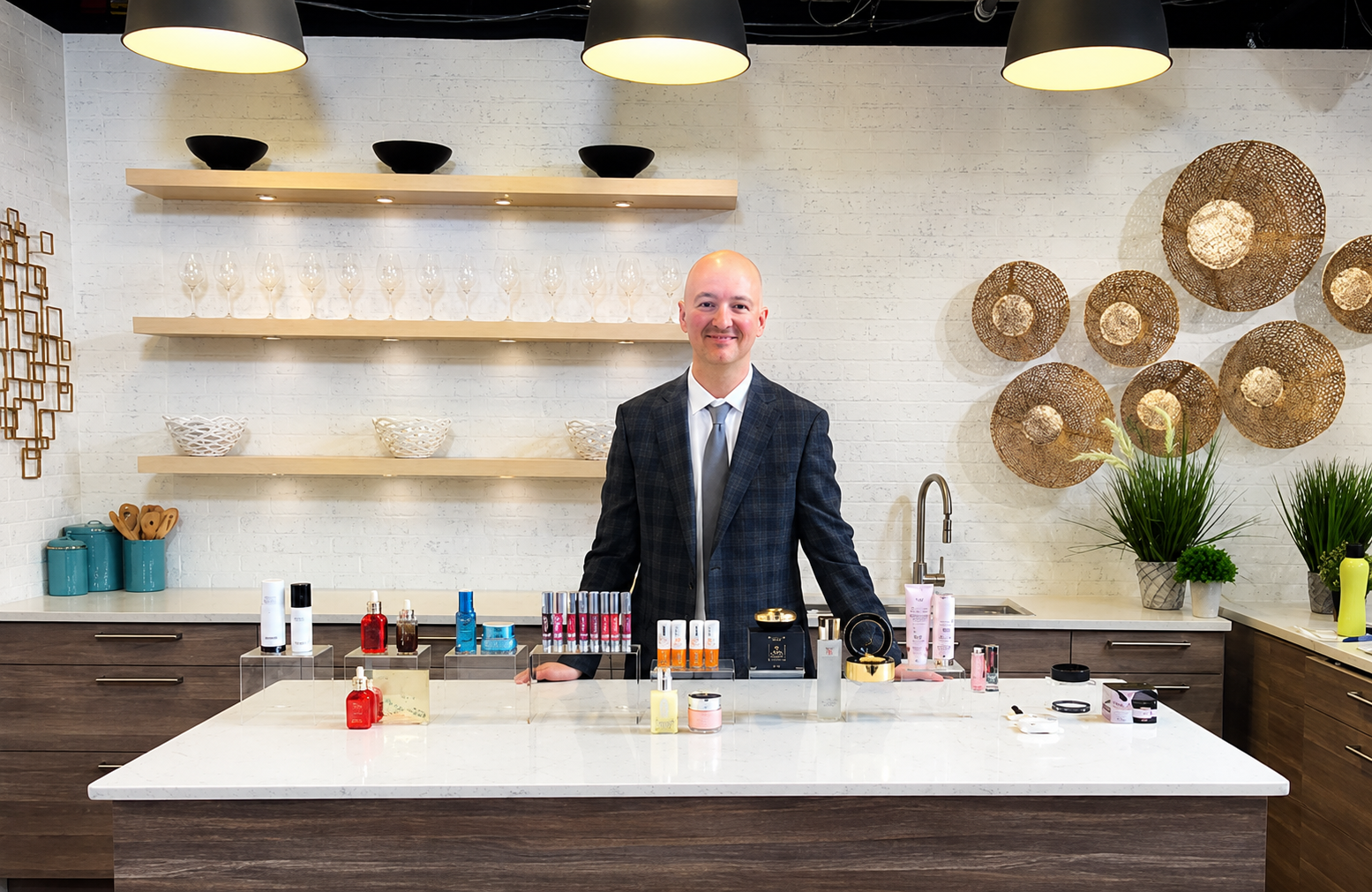
Few people have gone behind the scenes of the beauty industry quite like Dave Lackie. From touring some of the world’s most prestigious fragrance laboratories and interviewing legendary perfumers to uncovering the stories behind iconic beauty brands, the award-winning journalist and beauty expert has spent decades exploring what makes a product truly unforgettable. As fragrance enjoys a major renaissance—with younger consumers building “fragrance wardrobes” and scent becoming one of beauty’s fastest-growing categories—we caught up with Lackie to talk about the trends shaping the industry, how to find your signature scent and why perfume has become more personal than ever. —Noa Nichol
You’ve been inside some of the world’s most prestigious fragrance labs and have interviewed legendary perfumers. What is one thing about how perfume is created that would completely surprise the average consumer.
What shocked me most to learn interviewing perfumers about the process of composing a fragrance is how difficult it is to get all the ingredients to work harmoniously together. Many flowers and plant extracts actively ‘clash’ in a scent. A perfumer at Givenchy in Paris once told me that many notes don’t ‘play nicely with others’. She said they wanted to be the stars of the fragrance. Jasmine, for example, is one of the hardest floral notes to work with. She describes jasmine as spraying out of the bottle and doing an exotic dance on the cap, that’s how sexy and assertive it is. It takes a very skilled hand to balance all the citrus, floral and woody notes perfectly so you get this seamless composition. I was surprised to learn that rose has a unique ability to bring all the ingredients in a fragrance to meld perfectly. That’s why you’ll see rose listed in the heart notes of almost any fragrance. It’s a unifier.
Fragrance is one of beauty’s hottest categories right now. Why do you think perfume is having such a powerful cultural moment, particularly with Gen Z and younger Millennials?
The global resurgence of fragrance began when the Covid pandemic hit. Workers and students of all ages and backgrounds were suddenly ordered to work and study from home. Consequently, workplace ‘no fragrance’ mandates didn’t apply anymore. Men and women could enjoy wearing as much fragrance as they desired. The timing worked perfectly for many fragrance brands as they had launched scent discovery sets that allowed you to sample four to ten different scents at an affordable price. GenZ and Millennials started researching fragrances online and posting social media videos. A German influencer, Daniel Schutz, who calls himself Jeremy Fragrance on Tiktok became an overnight sensation and teen boys in almost every country followed his every recommendation. He has over 10 million followers on Tiktok and 2.54 million on Youtube. I remember fragrances selling out 24 hours after he posted a positive review.
When I interviewed teen guys for a feature story I wrote for the National Post, they told me that fragrance allows them to express who they really are inside. They said they can convey their personality with a single fragrance. Research company Circana followed this trend with a worldwide survey that revealed Gen Z considers fragrance ‘an essential’ daily product, not a luxury like in past generations. They buy more fragrance than anyone. Not only does it convey their true self, it is a mood booster. 80% of the Circana survey group said fragrance is critical for enhancing or lifting their moods.
And price doesn’t seem to be a factor. The most popular fragrance for the teen boys I interviewed was Creed’s Aventus. It’s priced at $650 for the Eau de Parfum. Clearly, fragrance has made an emotional connection with this generation.
What’s fascinating about this trend is it caught the industry totally off-guard. Nobody predicted that fragrance would become so popular. So they didn’t forecast and increase production. By the end of 2020, many brands had sold out of their most popular scents. It took a good 12 months to catch up.
The idea of having a single signature scent seems to be fading, replaced by ‘fragrance wardrobes’. How has the way we wear and shop for perfume evolved, and what does today’s collection say about its owner?
I think there are couple reasons for this. First, consumers are far better educated today than in past years. The number of TikTok and Youtube channels dedicated to fragrance is astounding and you can easily spend hours learning about different scents and fragrance houses. And I’ve noticed that many Gen Z fragrance enthusiasts create their own custom fragrances by blending hard-to-find scents with popular launches. It’s a status symbol to wear a fragrance nobody else has. They’ll spend hours composing their own scents using vial samples.
Secondly, the overall quality of fragrances has increased steadily over the past decade. Even celebrities wanting to launch their own fragrance are enlisting world-class perfumers to create their eaux de parfums. They know that the perfume industry is incredibly competitive and if they are going to make money, the product has to be really good. There are now quality perfumes that are tempting customers at all price points.
And finally, olfactory fatigue or ‘nose blindness’ comes into play with a signature scent that you wear every day. Our brain naturally filters out constant, familiar scents to conserve energy and stay alert. Once your nose identifies and registers a particular fragrance, you stop noticing it, even though the scent still lingers. I remember sitting beside fashion designer Jean Paul Gaultier at a lunch in Toronto and he told me this happened to him when he created his original Le Male fragrance. He would spray it in the morning and by the time he got to his office, he couldn’t smell it. So he’d spray it again. And then again. His staff had to come in and explain they could smell him a block away. (The solution is to regularly rotate five fragrances so your nose doesn’t have time to adapt to just one.)
After decades of smelling thousands of fragrances – from iconic classics to niche launches – what separates a truly exceptional perfume from one that is simply trendy?
Quality of ingredients. Fragrance is very similar to fine wine. An exceptional vintage wine begins with the finest grape harvest. It’s the same with perfumes. Perfumers have to have the budget in the brief for the fragrance to buy the best raw materials. Vanilla is a good example. The very best vanilla comes from a small island about 400 kilometers off the southeastern coast of Africa called Madagascar. This vanilla isn’t sweet, it’s actually dry with a remarkable depth and character. If a perfumer can afford to use this particular quality of vanilla, you’ll be able to smell the difference at first sniff.
Next, you need to look at the perfumer who created the fragrance. Perfumery is one part chemistry and one part artistry. The very best perfumers have the ability to blend notes seamlessly with a passion and love. Nathalie Lorson’s 2006 Perles de Lalique is a great example. The chypre-floral for her layers notes of rose, pepper, patchouli, oakmoss and iris into the most intoxicating and sensual aroma. Take a look at your favourite fragrances and research online who created them. That is the easiest way to find new scents you may love.
You’ve met some of the world’s greatest “noses”. What have those conversations taught you about the artistry, emotion and science behind fragrance that most people never get to see?
More than one perfumer has told me in interviews that there are actually more astronauts in the world than master perfumers. This is an absurdly competitive industry where perfumers have to pitch their ideas for a fragrance much like Dragon’s Den. A brand sends them the brief that contains the theme, target customer, fragrance style and the perfumer has to present his or her idea for the scent.
Becoming a perfumer is clearly a calling and passion. Every perfumer I’ve interviewed has shared how much joy and accomplishment they get from composing a scent. And each has his or her own way of working. Hermes’ former in-house perfumer Jean Claude Ellena created his fragrances to soft classical music. Guerlain’s Thierry Wasser insists on silence. Most fragrances take 12 months to complete from brief to approved scent. The actual perfume bottle can take two to three times longer than developing the actual scent.
Mr. Wasser, one of the world’s truly great perfumers working today, prefers working with ingredients of natural origin versus synthetic versions. He says real ingredients have a soul that you can smell in a perfume. There is something special these notes bring that he can’t explain but he can smell.
For someone standing in front of a fragrance counter feeling overwhelmed, what’s your foolproof advice for finding a scent they’ll still love months – or even years – from now?
Here’s is a foolproof method of finding a scent you’ll truly love. Begin by closing your eyes and inhaling the fragrance. What do you feel? What emotions come up? Don’t think. We tend to overthink when testing fragrances and scent is emotional. Trust your first impression.
Next, spray your wrist and wait for 20 minutes. That is how long it takes for a fragrance to interact with your skin’s unique chemistry. I’m often amazed at how much a scent can change over that time as it interacts with your skin. If you still love it after 20 minutes on your skin, buy it. It’s for you.
You’ve watched fragrance trends come and go throughout your career. Which current notes, ingredients or scent families do you think have real staying power, and which do you suspect as simply passing fads?
During times of social and political upheaval, people look for comfort. I think that is why we are seeing so many vanilla-based fragrances. Vanilla is soothing and sweet and calming. This note is appearing in almost every women’s fragrance today and starting to show up in men’s as well. I think you’ll see this continue for years to come. If you want to see where perfume ingredients are going just look at trendy food flavours. The big global perfume ingredient companies also create the flavours for restaurants and food manufacturers. It’s not a coincidence a few years ago that we saw so many restaurant entries and frozen meals using coconut and then saw coconut water in fragrances.
Many people don’t realize that how – and where – you apply perfume can dramatically affect how it wears. What you are your favourite expert tricks for getting the most out of a fragrance, from layering to longevity?
My first tip is to buy the right size of fragrance. 1 ml of fragrance equals 10 sprays. So if you are going to use this scent regularly, it makes sense to invest in a 100 ml bottle. If the scent is just for special occasions, go for the 30 ml bottle. The goal is to use every single drop.
Most commercial fragrances last 12 months once you open the package. After that, you may notice the scent smelling different. This can take place slowly. Keeping it in a cool, dark place with prolong its lifespan.
The traditional method of applying fragrance is to apply to the pulse points – wrists, behind the knee, base of the neck. This is because the blood is closest to the skin there and warms the fragrance allowing it to “bloom”. If you want your fragrance to really last, spray a hair brush and then run the brush through your hair. The scent will adhere to the hair follicles and last much longer. In France, the custom is to place a drop of perfume at the back of your neck so that when you walk, you leave a trail of scent. This is called “sillage”.
As both an award-winning beauty journalist and one of Canada’s most trusted beauty influencers, you’ve witnessed the industry’s transformation firsthand. How has social media changed the way consumers discover, experience and ultimately buy fragrance?
When I first started writing about fragrance, information about scents and new launches was largely controlled by the beauty directors at the major American fashion magazines. Beauty directors like Sarah Brown at Vogue, Sunhee Grinnel at Vanity Fair and Jean Godfrey-June were gatekeepers and decided what would be featured in the pages of these magazines. There was a time when it was difficult to find new brands.
Social media democratized fragrance in a really positive way. It allowed people with a passion for the topic to share their thoughts and opinions. You can literally find thousands of people talking about perfume today on Tiktok, X, Youtube and Instagram. What I would like to see on social media is more research put into the posts. I want to learn something about the brand or the fragrance that I didn’t know. There are too many that are just opinions.
I just read survey that says more people buy fragrance online without smelling it first which amazes me. They study the notes, the scent descriptions and look for posts about it before buying. If you’d ask me 10 years ago if people would be buying perfumes without smelling them I would have said you’re crazy.
You’ve spent your career telling stories behind beauty products rather than simply reviewing them. Of all the fragrance houses, perfumers and destinations you’ve visited – from Venetian perfume museums to French laboratories – is there one unforgettable experience that forever changed the way you think about perfume?
I have been so fortunate and honoured to interview so many perfumers, artists and celebrity spokespeople over the years. I think the most important thing to know is how much passion, artistry and love goes into every single fragrance. One of Giorgio Armani’s favourite perfumers, Julie Massé told me when she was creating Si Intense that she wore the fragrance daily for a full 12 months while she tweaked and perfected the formula. She described it as her ‘baby’. When it finally launched, she was walking down the street and a woman was wearing it. She turned and said, “Why is she wearing my fragrance?” Then she realized it was now everyone’s fragrance.
Probably the most incredible experience for a perfume lover is a visit to the Museum of Palazzo Mocengio , Venice’s Perfume Museum. It’s about a 20-minute walk from the main square and sits in a breathtaking palazzo building showcasing some of the world’s rarest perfume bottles. You can walk through rooms and discover how the art of perfumery thrived in the late 1500s. Perfumers guarded their formulas fiercely and would create custom fragrances so that lovers could identify each other through scent at the masked balls.
share:

June 26th, 2026 at 3:24 pm
You look handsome.Love your outfits Dave. Thanks for sharing all these behind the scenes tips.
June 26th, 2026 at 8:22 pm
Loved the article. I do love to read about your views on fragrance, your knowledge runs deep.
June 28th, 2026 at 12:40 am
This article is very interesting because it provides deep insight into the perfume world from a perspective that is rarely seen by the public. The explanation of how fragrance has become an important part of personal identity, especially among Gen Z, is very relevant to current trends. In addition, the insight into the perfume-making process and the role of perfumers shows that behind every scent there is both art and science. It is very informative and opens up a new perspective on the modern beauty industry.
June 29th, 2026 at 12:50 pm
When it comes to fragrance knowledge and trends you’re the perfect person to answer Noa Nichol questions. Dave, I can’t imagine buying a fragrance without trying it first either. I’ve tried perfumes that don’t blend well with my body chemistry. Your 20 minute rule has been my savour many times it also removes the pressure and guilt of buying a fragrance on the
spot. Dave your opinion is worth its weight in gold.