
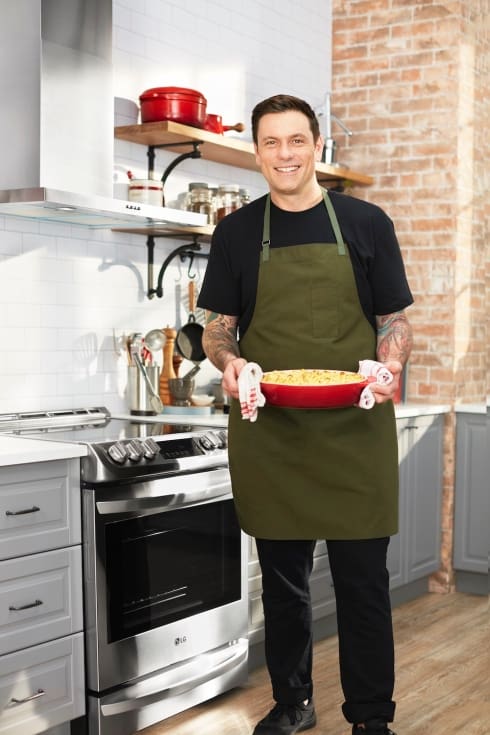
Let’s face it: we’re all guilty of food wastage at some point or another, whether it’s that we’re too lazy to scrap the bottom of the peanut jar or don’t like the look of the slightly shriveled grapes. But as insignificant as it seems in our small kitchens, these bad habits spell big bad news for the planet. Fortunately, celeb chef Chuck Hughes has teamed up with LG Canada on a video series showing us how to reduce food waste in our own homes, and below he shares more with us, exclusively, on the project. —Rachel Johnston

Hi Chuck! What are the main topics you tackle in the Continuous Kitchen series?
The concept of the LG Continuous Kitchen is simple. Food waste is an issue in Canadian homes so, I’ve teamed up with LG to show people how to reduce food waste at home. It’s a five-part video series and we are showing people how to make different meals from food already in their fridge or cupboard.
Canada was recently called out as having a higher-than-normal level of food wastage. Why do you think that is?
I recently learned that $31 billion worth of food is wasted in Canada annually and 47 per cent of it happens in our own kitchens. According to the Commission for Environmental Cooperation, Canadians are among the largest wasters of food in North America, with approximately 873 pounds wasted per capita per annum. The restaurant industry has always focused on getting the most out of their ingredients, which in turn means wasting less food. I am hoping to pass along some of those ideas that will encourage people at home to make better choices. And just like in a restaurant, get people to realize that every vegetable kept out of their compost or each piece of meat kept out of their garbage will mean more money in their pocket.
What are some simple ways we can reduce our food waste?
You can reduce food waste at home with a little creativity and some planning. Before you head to the grocery store, know what’s in your fridge. Food waste starts with over-buying food. If you find yourself throwing out food before you can use it, you bought too much. Make sure you rotate your stock. Basically, get out with the old and get in with the new. New items go behind the same older items—so the older items get eaten. The LG InstaView fridge is good for this. Veggie snacks for kids can be put in the door-in-door panel instead of having your kids rummage through the fridge. But sometimes life does not always go as planned—if a couple of veggies have been left behind and are bit off their prime, don’t ditch them. Put them in a soup or pickle them. Ensure you’re storing your food properly. Keep your meats, drinks and vegetables separate in the right areas of your fridge. Another great way to reduce food waste is to plan meals ahead. Head to the store with a plan for what you need to cook for the week instead of buying items as you see them.
Can you recommend some delicious recipes that are ideal for using up leftovers?
I’m a big fan of chicken pot pie, based on a leftover that is pretty common in Canada: chicken. It can be made with some simple ingredients that are probably already in your fridge and cupboard. If you are using a roast chicken be sure to keep your bones to make a stock. Try my recipe below, and find more great leftover-based recipes here.
Are there tools and appliances we can implement into our kitchens to decrease our wastage?
Keep it simple and set yourself up with a good knife and a good cutting board. Organize everything so it will be easy to do—in the restaurant business we call this "mise en place"—and be comfortable and make cooking fun. A good fridge will help extend the life of your food. We always keep fish on ice in the restaurants and chill drawers, like LG’s CustomChill drawers, in your fridge work that same way.
What else does the Continuous Kitchen series highlight?
Delicious, stand-alone recipes that will help you reduce your food waste at home, which in turn will save you money. A win-win-win.
Chuck Hughes’ Chicken Pot Pie Leftover Recipe
1 oz butter
1 oz flour
2 cups chicken broth
Leftover roasted vegetables
Leftover chicken, cubes
Leftover mashed potatoes
2 eggs
In the same pan, melt butter over medium heat. Stir in flour until well blended. Gradually stir in broth. Simmer, stirring constantly, until the sauce thickens and boils (you will think this is TOO MUCH liquid, but it’s not). Remove from heat and add the chicken and vegetables to the broth and stir to combine. Season. Mix 1 egg into the mashed potatoes and fill a piping bag. Fill mini casserole dishes, and pipe the mashed potatoes on top. Brush the topping with egg wash. Bake at 350 for 15-20 minutes until hot in the middle and the mashed potatoes are golden, crispy and fluffy.
share:

Be the first to comment