

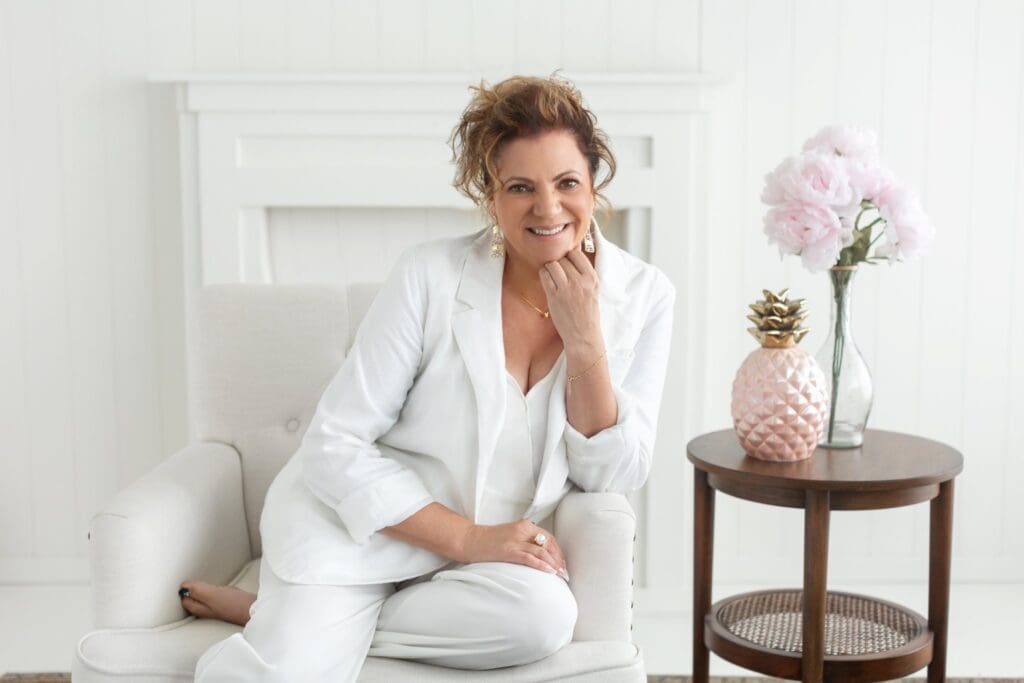
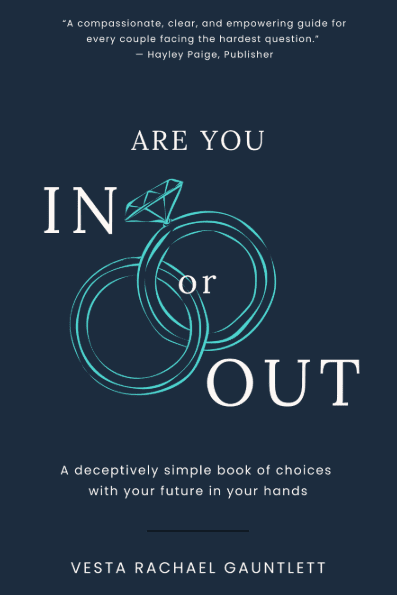
In a world of overthinking, overanalyzing, and staying stuck in the past, relationship expert and author Vesta Gauntlett is cutting through the noise with one bold, clarifying question: What’s next? In her new book, Are You In or Out? (out February 24), Vesta invites couples to stop replaying old wounds and start making intentional choices—whether that means recommitting with clarity or bravely choosing to walk away. Grounded in self-worth, honesty, and joy, her approach reframes love as a conscious decision, not a default setting, and offers a powerful roadmap for couples navigating life’s many “after” moments together. —Noa Nichol
Your book asks a deceptively simple question—Are you in or out? Why do you think so many people avoid answering it honestly, even when they know something isn’t working?
The fear of change and the fear of the unknown are powerful inhibitors. Even if one knows something isn’t right, or is uncomfortable, often people stay because the fear of the unknown is too strong. It takes courage to ask the question “Are you In or Out?” I hope the book (Are You In or Out?) offers that support to those who are afraid to take the first brave step.
You challenge the idea that endlessly revisiting the past leads to healing. How can couples honour what they’ve been through without getting stuck reliving old pain?
In reality, this can be the quickest step in the process, decide from this point forward that we acknowledge what led us here and we choose to decide where we go next. Together. The key is both partners must mean it. If you are choosing to stay, the only path you control is what is next.
The book strives for clarity on where each partner stands, what does clarity actually look like in practice when emotions, history and fear are involved?
Clarity offers a new lens in which to view and focus on next steps. Yes, there will be emotions, history, and fear to be considered, but the best way to process them is to decide their role in your new future.
Many people stay in unhappy relationships because they’re afraid of how leaving will look to others. How do you help clients separate external expectations from their inner truth?
I stress that we cannot control what other people will say, how they will judge us, or the narrative. But we can walk in our own truth. I remind them that no one knows what happens inside a marriage except the two people in it. If you spend too much time worrying about others’ perceptions, it simply delays a life lived in joy.
The WIN Vision Board is one of the most talked-about tools in your retreat or Marriage Adventure Event. Why is creating a shared future vision so much more powerful than fixing problems one by one?
The concept was developed when I realized that two people working towards a shared future, need a shared vision. By incorporating each partners goals and dreams in one vision, each shared step towards reaching those goals is shared as well. We can strive to support our partner and be supported as well. When things get hard, and they will, knowing you are both working toward the same goals, leads to increased intimacy, connection, and excitement for What is Next.
In your experience, what’s the difference between enduring a relationship and actively choosing one—and how can someone tell which camp they’re in?
If you feel that you are compromising yourself for the benefit of your partner, you are enduring. If you dread spending time with them, or feel that you are putting on a show, walking on eggshells, or cannot be yourself-you are enduring. When you feel valued, respected, and cherished, you can actively choose to be a willing participant in the marriage.
Your book explores the “after” moments—after kids, after career shifts, after major life changes. Why are these transitions such pivotal crossroads for couples?
These transitions present couples with a new reality, oftentimes they delay the big conversations or changes until…fill in the blank. These difficult conversations are all saved until the transition time is unavoidable. That makes it even more challenging to address so many changes. It can make it so difficult in fact, that most marriages don’t survive these transitions. They are so pivotal because they force a couple to decide what to do next, similar to the concept of the book.
How do you guide couples who realize they no longer want the same future—but still deeply care for one another?
I suggest they honor their relationship and each other. Show respect as they move forward, even if it isn’t together. There is nothing preventing them from staying friends and being in each other’s life. I would encourage a discussion about what they meant to one another and what they want to mean to one another in the next phase of their relationship.
You emphasize joy as the true measure of relationship success. Why do you think longevity has been overvalued compared to happiness and emotional health?
I believe this stems all the way back to the development of marriage in itself. It was created to protect, connect, and share a life, but it was not based on today’s complex lifestyle and longevity. That isn’t to say that I don’t believe in long term marital success, it just means that the needs and the growth to keep a marriage happy and emotionally healthy are far more involved now than when the lifespan was closer to under 40 years.
For someone feeling stuck between guilt and fear, what’s one small but meaningful step they can take toward clarity right now?
I suggest they close their eyes and think about their life exactly the way it is today-and then imagine it is exactly the same in five years. If they are certain they don’t want that life, then I guide them to take the steps now towards a new life. You don’t have to know the exact steps to move towards clarity, but you do have to take the first one.
How does choosing yourself—whether that means recommitting or walking away—ultimately strengthen families and communities rather than weaken them?
I believe if you are honest with yourself, respect yourself, and demonstrate that confidence it will resonate with your family and friends. It may even be the example they need to foster the same changes.
If readers take away just one mindset shift from Are You In or Out?, what do you hope it is—and how could it change the way they love moving forward?
Marriage success is a choice. Both parties must choose. It is not a one and done at the altar. It is an active choice every day to ensure your partner feels loved, respected, and cherished. That everyday your goal is to show them that you choose them and the life you share. Bottom line: love is a choice, choose wisely.
share:

April 3rd, 2026 at 1:02 pm
Hoi, ik snap de aantrekkingskracht van trends die comfort combineren met een opvallende stijl, vooral wanneer je na lange werkdagen iets wilt dat makkelijk zit maar toch een beetje eruit springt, en tijdens het browsen kwam ik toevallig luckywave tegen, wat me meteen opviel waren de bonussen voor spelers uit België, ik probeerde Book of Dead na een reeks verliezen en stond op het punt te stoppen, maar besloot toch iets meer risico te nemen en pakte uiteindelijk een mooie winst, sindsdien ga ik er af en toe terug naartoe als ik gewoon even wil ontspannen zonder teveel na te denken