
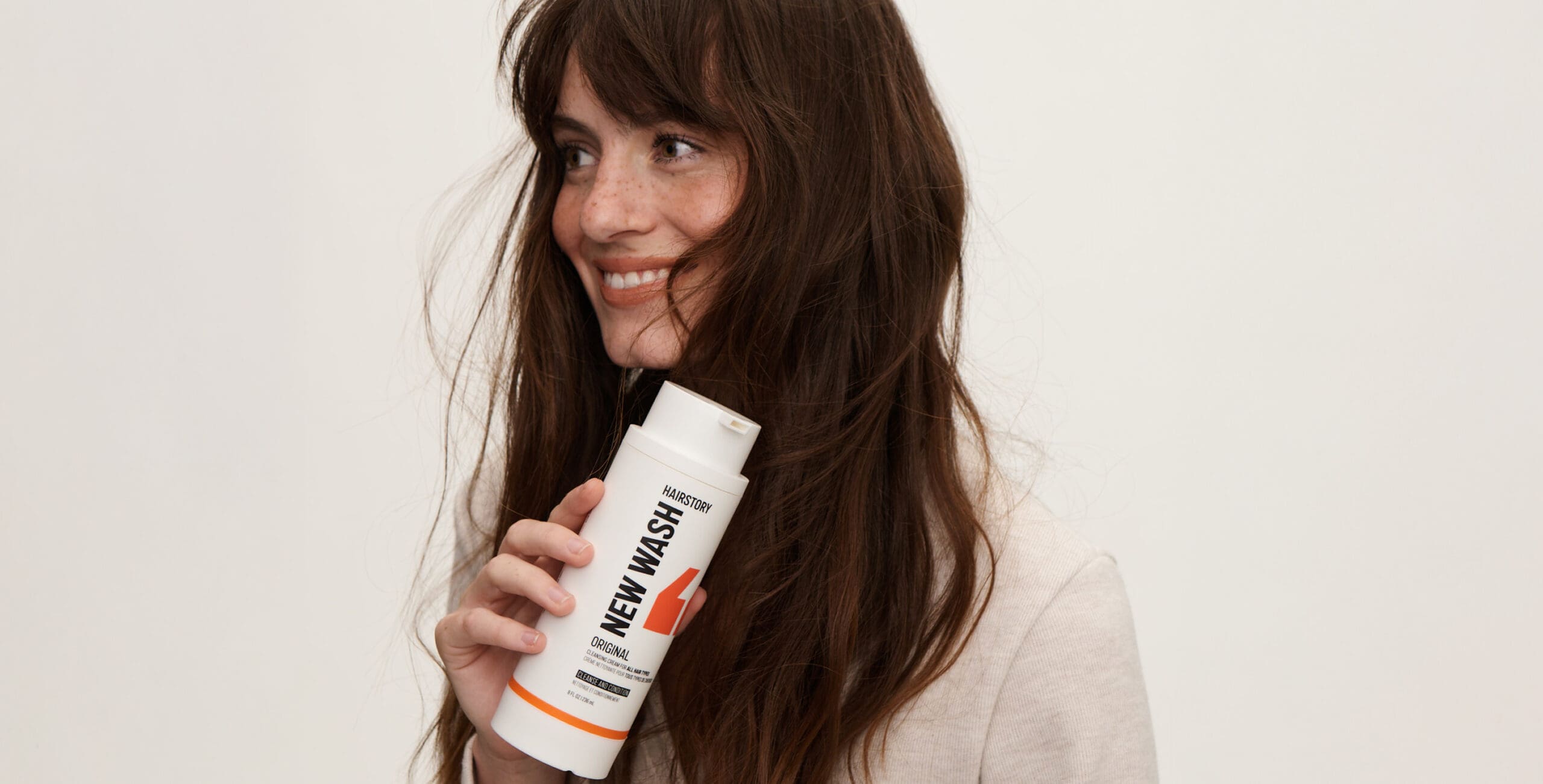
As natural formulas and microbiome-friendly beauty surge, Hairstory continues to challenge everything we thought we knew about washing our hair. With nearly one million devotees and a newly reformulated New Wash, the brand proves that cleansing doesn’t need bubbles to work. In this Q&A, Dina Rosenbloom and Wes Sharpton share how Hairstory redefined clean hair, why hairdressers—not marketers—should lead product innovation, and what the future of haircare looks like when you finally ditch the shampoo myth. —Noa Nichol
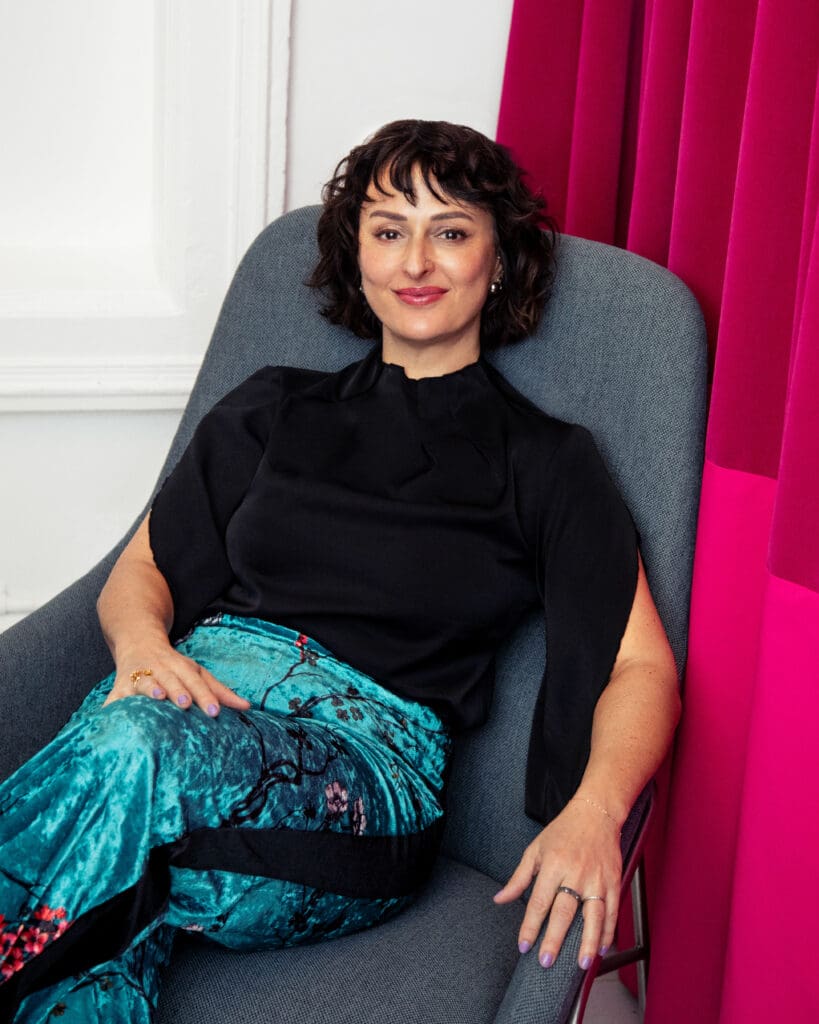
CEO Dina Rosenbloom
You’ve built Hairstory on the idea that traditional shampoo isn’t the best way to clean hair. What did you uncover—scientifically or anecdotally—that made you confident enough to challenge such a deeply ingrained habit?
When Hairstory launched in 2015, it did so in collaboration with hairdressers that – perhaps surprisingly for that time – professed that shampoo was never the best way to clean hair. Its promotion harboured a dark secret; shampoo keeps hair unhealthy, and pockets deep. The reason for this is because shampoo contains detergents (foam) which strips the hair and scalp and ultimately, leads to requiring repair measures in the form of conditioner, masks, treatments. Each wash starts the strip-repair cycle over again.
Hairstory’s Co-Founders were fed up with this shampoo myth and created a better, healthier way to wash by pioneering a totally new category of cleansing creams. Our hero product New Wash is a detergent-free cleansing cream that replaces the need for multiple products; it cleans without stripping, conditions, balances the scalp and protects color in one step. It’s the low maintenance answer to hair that is healthier, softer, shinier, and with longer lasting colour and happy scalps. In addition, Customers also report less fall-out/thinning, and it’s also fantastic for air-drying, reviving hair’s natural texture.
Microbiome-supporting formulas are shaping beauty in 2026. How does New Wash work with the scalp’s natural ecosystem rather than disrupting it like traditional foaming cleansers?
Traditional shampoos contain harsh detergents that strip away our natural protective barrier and destroy the microbiome, leaving hair and scalp tight, and dry and irritated, as well as over-producing oils (to repair what’s been stripped). Conditioner is then used as a band-aid to cover the damage shampoo causes; this weighs hair down, and comes with a financial cost too. New Wash cleans in a totally different way: it removes impurities with gentle essential oils and fatty alcohols. It clings to everything that doesn’t belong – such as oil, dirt and buildup. But it doesn’t cling to our natural protective barrier and this is unique; our scalp’s ecosystem was never designed to be stripped and disrupted.
As you mention, New Wash does not foam; it feels like a conditioner when you apply it and the in-shower process then turns it milky. When it’s rinsed away, hair is left totally clean – but not stripped – and so soft! Scalps are also left calm and intact.
New Wash was reformulated after nearly a decade as a cult product. What prompted the update, and what does the new version do better for today’s consumer?
We’ve come a long way since we first launched in 2015, and yet, our brand values and our stance on haircare remains the same; we believe that we need fewer, better things and we equip our customers to do more with less, ultimately delivering exceptional low-maintenance routines. Our 2025 update saw a bold brand refresh to fit our personality, and we also updated New Wash to be vegan; Keratin has been replaced with Baobab protein, which means New Wash is now detergent-free, sulphate-free, phthalate-free, paraben-free, biodegradable and vegan, as well as being leaping bunny certified.
We also introduced our Better Bottle™, an endlessly refillable bottle specially designed for thicker creams which enhances the New Wash experience. This sits sturdily in the shower, is anti-mould and at the end of its life, fully recyclable. Lastly, we introduced a small edit of truly groundbreaking products. We only bring new products to market when it is innovative/when there is a need, and one of our launches is Pre-Wash, a micellar scalp rinse which is a great supplementary product to those first transitioning from shampoo to a cleansing cream.
The idea of a one-step product that cleans, conditions, balances the scalp, and protects colour feels almost counter-intuitive in a multi-step industry. Why is simplicity actually more effective for long-term hair health?
Hair health is everything! But you’re right, haircare brands typically exist to sell products. The difference with Hairstory is that those that try New Wash love it and often end up subscribing for life! They can no longer go back to multi-step routines. For us, longevity of hair health and loyalty from our customers go hand in hand.
Another benefit is the time saved on your shower/styling routine; time is precious and a low-maintenance haircare routine that delivers the best hair of your life with little effort is very appealing.
We also work closely with the hairdressing community which are the original influencers of the world. We teach our hairdressing network of almost 5k hairdressers’ skills to enhance their business, and each time they refer a client to us, they are rewarded with lifelong commission. This ultimately props up the hairdressing trade which is an essential industry to us and our customers.
With nearly one million customers now using New Wash, what shifts are you seeing in how people think about wash frequency, product overload, and low-maintenance beauty routines in 2026?
Some of the feedback we receive regularly is that when customers switch to New Wash, they need to wash their hair a lot less frequently and this is because their scalp isn’t over-producing oil from where it’s previously been stripped. It’s also fantastic for air-drying because the hair’s natural texture is enhanced and so ditching shampoo in favor of a cleansing cream really has a huge impact on haircare routines. There is definitely a shift towards ‘slower’ beauty and the truth is that even the best hairdressers in the world only need a handful of products, so long as those products work well.
Another point to add which is relevant to over-consumption is that consumers are more environmentally aware nowadays. Hairstory is proud to be not only better for hair and better for hairdressers, but better for the planet too! Using New Wash reduces our carbon footprint by cutting packaging in half (one product instead of several) and reducing water-consumption (one rinse instead of two). In addition, we have a catalogue of sustainability efforts from our refill pouches to our donations to water organizations and so much more.
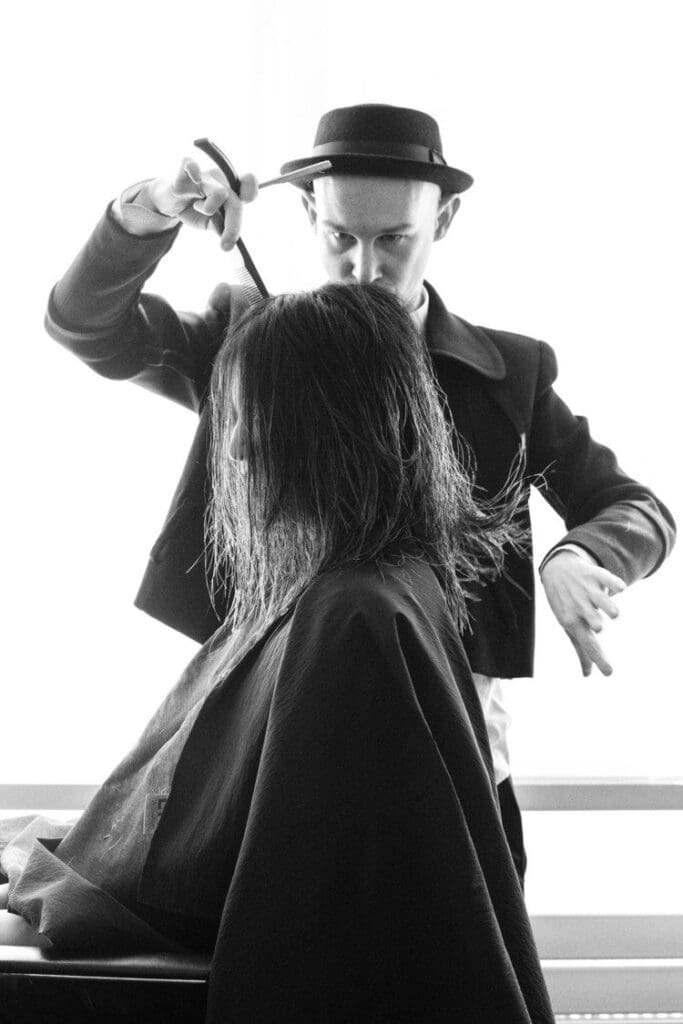
Resident Hairstory Hairdresser Wes Sharpton
When a client sits in your chair for the first time, what are the most common signs you see that traditional shampooing has been stressing their hair or scalp?
The scalp often tells the story first – it can look red, irritated, dry, or itchy. Beyond what I see, there are also key phrases clients say that immediately signal “shampoo stress.”
Things like: “My hair is always dry,” “It’s unmanageable,” or “I can never air-dry because it turns frizzy and doesn’t feel soft.” When someone feels like their hair only behaves after heat styling, that’s usually a sign the scalp and natural oils have been stripped too often.
New Wash doesn’t foam, which can be surprising for clients. How do you explain the cleansing process—and what reactions do you see once they actually try it?
Before I ever started using New Wash, I’d run into clients on the street and say, “Your hair looks amazing.” Almost every time, they’d answer, “I haven’t washed it in days.” That always stuck with me. It told me the best hair wasn’t happening on wash day—it was happening after.
Traditional shampoo gives you that immediate squeaky-clean feeling, but it often comes from stripping the scalp. New Wash works differently. It cleans the scalp right away without disrupting its natural balance, so you don’t have to “wait” for your hair to recover.
Clients notice the clean, fresh scalp on day one—but day two is when they’re sold. The hair is softer, calmer, and more manageable, without dryness or frizz. Once they experience that, giving up foam feels like a very small trade-off.
From a stylist’s perspective, how does microbiome-friendly cleansing change the way hair behaves over time—texture, shine, colour longevity, or scalp comfort?
The scalp microbiome plays a huge role in hair health—forming a barrier against pathogens, regulating sebum, and reducing inflammation. When you protect that environment instead of constantly disrupting it, everything improves.
A cleanser that’s strong enough to remove excess buildup but gentle on the microbiome delivers results people care about: colour isn’t stripped, hair looks shinier, and the scalp feels calm. But the biggest change? Healthy hair doesn’t need to be manipulated to look good. It behaves naturally. That’s what makes the routine feel effortless.
Many clients want “low maintenance” hair but still expect high performance. How does a one-step cleanser like New Wash actually make hair easier to manage between appointments?
We’re in a new era of haircare and, honestly, of the beauty industry. Before, it was about control: How do we force hair to look a certain way?
Now, clients want healthy hair because they don’t want to fight it. They don’t want someone else’s hair—they want the best version of their own. A one-step cleanser supports the hair instead of overpowering it. When the foundation is healthy, everything else becomes easier.
After working with clients who’ve switched away from traditional shampoo, what’s the biggest transformation you’ve witnessed—both in their hair and in their relationship with their routine?
Fine-haired clients surprised me the most. I’ll be honest—I was nervous at first. I’ve been bald for about 15 years now, but when I had hair, it was very fine. I think that’s why I naturally built a clientele of fine-haired people and never shamed them.
I worried a cream cleanser would weigh their hair down—but it did the opposite. The hair became lighter, more airy (which sounds strange, but it’s the best way to describe it). Over time, the strands still felt fine, but stronger.
The real transformation is time. Most people want that “lucky hair”—the kind that looks great without effort. This gives them that, and it gives them a lot of time back on wash day. And that changes their whole relationship with their routine.
share:

February 12th, 2026 at 9:44 pm
This article offers a fascinating look at how modern haircare is evolving toward gentler, more effective routines that benefit overall hair health. I especially enjoyed the insights on caring for all types of hair — including wigs — as part of a complete hair-care approach in 2026.
April 17th, 2026 at 12:46 am
Ik kwam dit platform tegen via een artikel op een tech-blog over digitale hobby’s in Nederland. Wat me direct aansprak was de sfeer die retro zino uitstraalt, echt anders dan de rest. Ik heb me een avondje vermaakt met de online slots en de graphics waren verrassend scherp op mijn tablet. Na een paar spins had ik al een leuke winst te pakken, wat mijn avond helemaal goed maakte. De uitbetaling verliep gelukkig ook erg vlot.