
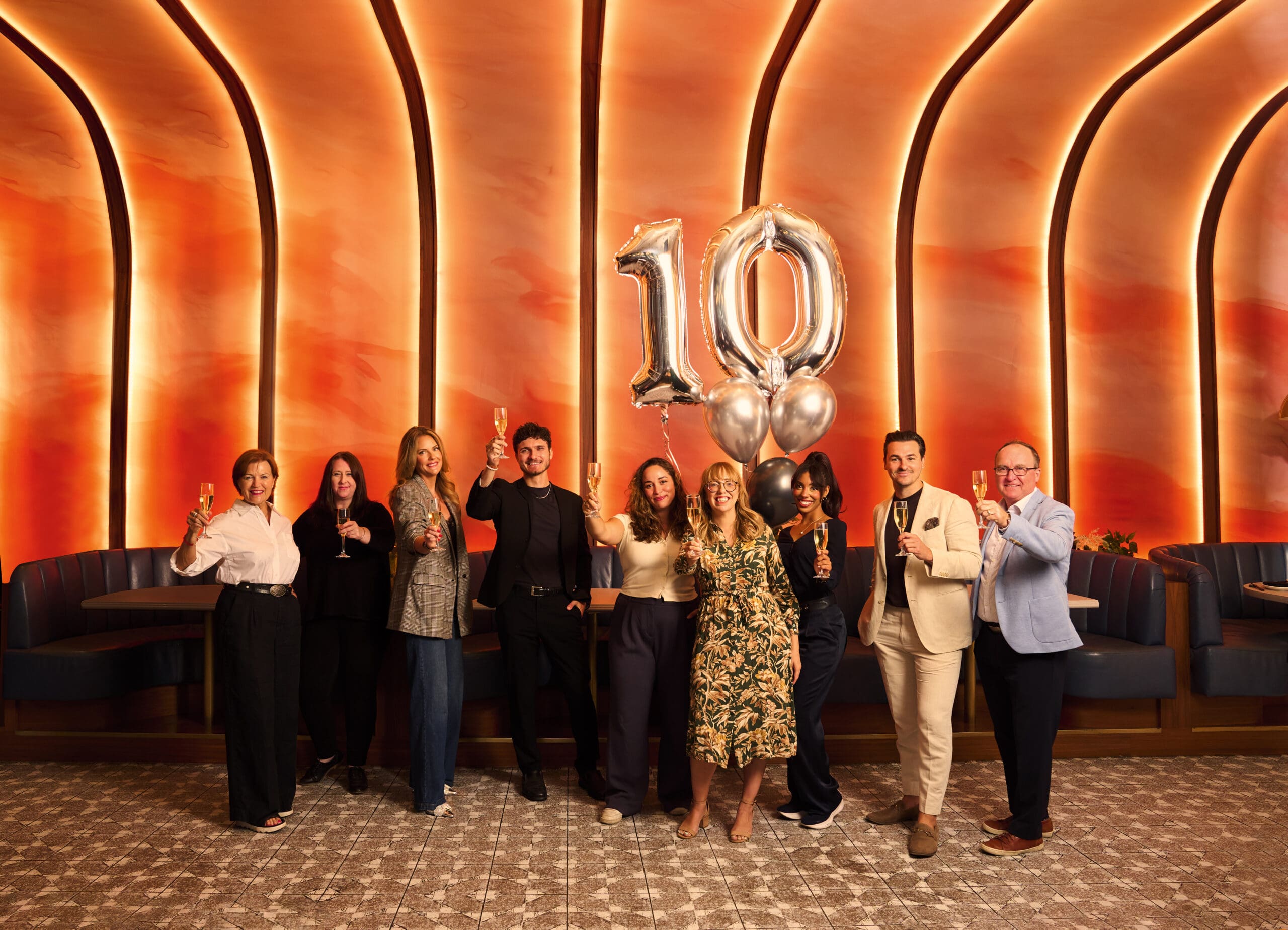
Magazine foodism just turned 10—and to celebrate, we’re sitting down with founder-publisher Krista Faist and editor Katie Bridges to talk about the stories, the risks, and the restaurants that helped turn Toronto into a global food city. From keeping a free print magazine alive to launching Escapism’s restorative travel features and the new foodism Feed, this Q&A digs into the wins, the pivots, and what’s next for a local brand with national appetite. —Noa Nichol
Happy 10th! Looking back, what’s the most surprising way Toronto’s dining scene has changed since foodism first launched?
KB: As a lover of cocktails, I’m thrilled to see how eclectic Toronto’s bar scene has become. From whisky fat-washed in bacon to more unusual savoury spirits like aquavit popping up on cocktail lounge menus across the city, we’ve come a long way from a vodka cranberry! Spots like Bar Chef have really paved the way for mixologists to be more creative, and it’s led to Toronto becoming one of the world’s premier cocktail cities. There’s a reason why Toronto hosted World Class this year — homegrown talent has secured the title four times since 2017! It’s also been nice to see farm-to-table become less of a trend and more of a concerted effort incorporated into restaurant menus. We have a lot to love, and the spoils of our bounty are delicious.
KF: I’d say the two biggest changes have happened in the last few years. The pandemic fundamentally shifted how restaurants operate and forced them to look at takeout options, optimizing their space and setting new standards for health and safety. It also brought some cool new opportunities too with the bylaws changing to allow more permanent outdoor seating and allowing the sale of take away alcohol. Restaurants and how they operate are much different as a result.
The second thing that’s really impacted the industry is the Michelin Guide coming here. It’s provided a benchmark of excellence and put our industry on the worldwide stage. It’s nice to finally see us getting the attention we deserve!
If foodism were a dish, what would it be—comforting poutine with a twist, or something more high-concept like a deconstructed butter tart?
KB: If foodism were a dish, it would be something in between comforting and high-end: approachable, satisfying, but with a little twist you didn’t see coming. Think of it as your in-the-know friend whose restaurant recos always come through — the one with a Notes app full of spots to try. Sure, she’ll get excited about a buzzworthy new tasting menu, but she’s just as happy with a slice from a dive bar. If foodism had a flavour, it’d be a deli sandwich on housemade focaccia, stacked with local mortadella, melty cheese, crispy onions and a drizzle of hot honey: functional, filling, and delightfully unexpected.
Toronto has become a true global food city. What’s one hidden gem spot you discovered before anyone else was talking about it?
KF: This feels impossible to answer because everyone is so quick to claim ownership of somewhere so I find it hard to call anything a truly hidden gem. But I will say that I was one of the very first people in the doors at Aloette in 2017 and I haven’t shut up about it since. Their squash dish was and is one of the best things I’ve ever eaten. I was a loyal take out customer during the pandemic before they had opened their to go chain.
Krista, as publisher, you’ve built foodism through some pretty turbulent times in media. What’s the “secret sauce” that’s kept the magazine thriving (and free!) for 10 years?
KF: I’ve built the business on a few core beliefs: One is that generally speaking people want to help, you just have to ask them. In the early days of the business I had just moved back to Toronto and was re-establishing my rolodex so to speak. I reached out to everyone I knew from my past marketing life and anyone else I felt relevant to what I was building. I met as many people as I could and leveraged these connections in whatever ways I could.
Another belief I’ve had is that while our industry is likely going to change rapidly with technology, shifting consumer habits etc (which has proven beyond true!) it’s better to let it happen then react prematurely
Katie, as editor, you’ve eaten your way through endless restaurant openings. What was the most memorable bite of your career so far?
KB: I viscerally recall eating at Bar Isabel for my birthday and enjoying the roasted bone marrow, quickly followed by a bone marrow luge featuring a shot of cognac. That was the bite that sealed the deal — I knew Toronto was special and that I needed to be a part of its inner food world. The Korean Fried Chicken at 416 Snack Bar is one of my favourite bites in the city. It’s a little bit sweet, with some ginger and gochujang, and best of all, it’s on a skewer. Everything at White Lily Diner is impeccable, but the donuts are impossible to pass on. Flavours are seasonal, so it’s a bit of a lottery, but I had one filled with rhubarb once and it blew my mind. Also, the burger at Ricky + Olivia, with its kinda-sweet Filipino bun, made my eyes roll back in my head. Unreal.
Let’s get personal: what are your go-to comfort foods in Toronto when you’ve had a long week—late-night pizza slice, Chinatown noodles, or a perfectly messy roti?
KB: A leisurely dim sum the morning after a big night is the perfect place to patch souls back together and literally and figuratively pour the tea. Rol San in Chinatown is a distinctly Toronto experience. The food arrives fast, the brusque service is on right side of frosty, but lunging across the lazy Susan for one last, delicious shumai or pork bun is the dining equivalent of a warm hug.
The anniversary issue is called the “Comfort Issue.” What’s one comfort dish that feels like home to each of you, no matter where in the world you’re dining?
KB: Carbonara is one of those dishes that’s so beautiful in its simplicity. It’s just spaghetti, pancetta or bacon, eggs and parmesan, but it’s so satisfying, especially after a long day when you need a boost. The classic recipe calls for just the yolks, so I’ll often save the egg whites and shake them up in a sour cocktail.
Foodism is all about championing chefs, bartenders, and hidden gems. Who’s one Toronto culinary voice you think everyone should be watching right now?
KB: He’s already well established, but one person raising the bar (pun intended) who doesn’t always get the flowers he deserves is David Greig. He’s a partner and co-owner at Jen Agg’s hospitality group (Bar Vendetta, Le Swan, General Public), and is responsible for some of the city’s tastiest sips. I still dream about Werewolf, his classy-as-hell riff on the pornstar martini.
If you could only eat at one Toronto restaurant for the next decade (we know, impossible!), which spot would win your loyalty and why?
KB: I love DaiLo, and I think Nick Liu is a magician. The octopus tacos and the Hakka Brown Wontons are incredible dishes, but there’s usually a seasonal dumpling on the menu that’s out of this world. Ginger is also a reliable staple for me, and might be more budget-friendly looking ahead for the next decade! The vermicelli with spring rolls and grilled chicken is perhaps my most ordered dish of all time.
Finally, champagne moment: when you look ahead to foodism’s 20th anniversary, what do you hope the Toronto food scene—and your own plates—will look like?
KB: I hope farm-to-table becomes less of a marketing label and more of a genuine way of life. Here in Ontario, we have so much to celebrate and enjoy, and it feels like we’re moving toward eating more seasonally and reining in our hyper-global palates. We’re also drinking less these days, so it’ll be interesting to see whether the lower-ABV trend has staying power or if it’s just a passing phase.
share:

Be the first to comment