
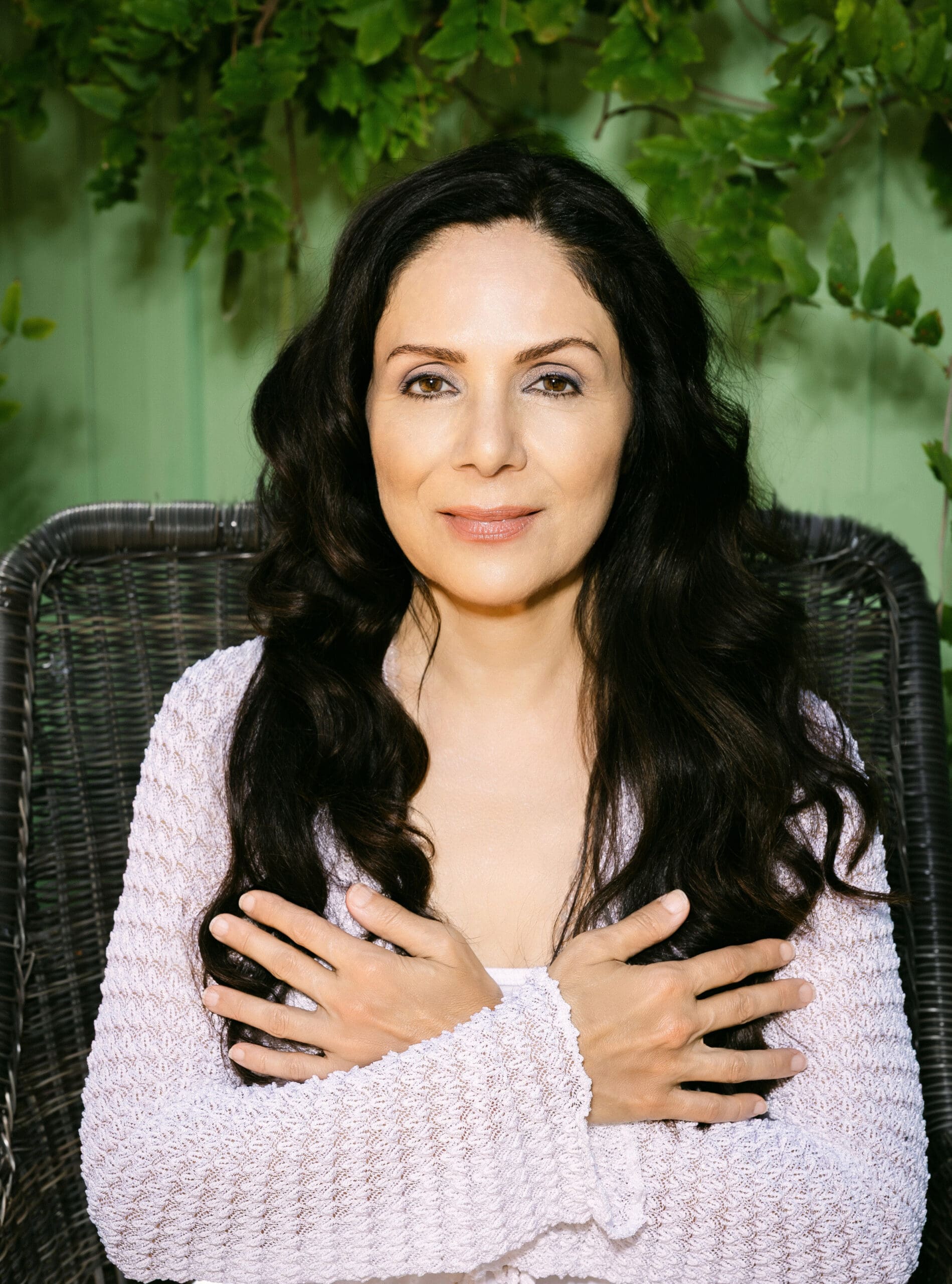
Yoga may begin on the mat—but embodiment doesn’t end there. In this Q&A, master sacred dancer and spiritual teacher Banafsheh Sayyad introduces Dance of Oneness, a fluid, expressive “sister practice” to yoga that carries mindfulness into motion. Drawing from Taoist wisdom, Tai Chi, and Sufi whirling, Banafsheh explores how rhythmic movement can release emotional blocks, awaken the divine feminine, and turn everyday motion into a living meditation—no stillness required. —Noa Nichol
Many people experience yoga as a place of stillness and grounding. How did you come to see sacred dance as a natural “next step” for embodiment beyond the mat?
I didn’t actually move from yoga to dance. Dance has always been my primary practice. I’ve taken yoga over the years and I respect it deeply.
For many people, sacred dance can feel like a natural next step beyond the mat because it both extends what yoga already cultivates—presence, devotion, and inner listening. It also offers another pathway into surrender: less through holding form, and more through letting go and being moved by rhythm, breath, and spirit. On the mat, you train focus, alignment, and steadiness; in sacred dance you bring those capacities into the body through motion and let the practice become creative and artistic. You’re moving with music and space—often inside a shared field with others—where embodiment includes how you relate with others, not just what you feel inside.
It’s not “yoga vs. dance.” Yoga builds the foundation. Sacred dance, the way I teach it, also builds that foundation and expands it into artistry, community, and surrender to the Beloved—to be danced.
Your upcoming book, Dance of Oneness introduces sacred movement as a sister practice to yoga. What does sacred dance offer the body and spirit that static postures sometimes can’t?
Sacred dance offers everything yoga offers—breath, presence, devotion, embodiment—but it delivers those qualities in motion, through rhythm and creative expression. Static postures can be very powerful for alignment, strength, and inner listening. Sacred dance adds what movement makes possible: you practice staying connected while energy is shifting. You learn to remain rooted while you’re in flux—turning, spiraling, swaying—so the nervous system and the heart both become more resilient and more coherent.
It also cultivates sensuality in the true sense, a deepened intimacy with sensation, rhythm, and pleasure in being alive. And it brings in artistry. You’re not only sensing the body, you’re inhabiting it as an instrument of expression, letting what’s true take shape through movement. Movement to music gives you a direct way to process and release emotion without having to analyze. You can transform what you’re carrying—grief or stress—into clarity and joy. And because sacred dance is often practiced in a shared field, it can be relational: you’re attuning to rhythm, space, and the presence of others, which activates a dimension of embodiment that’s different from a solo practice.
You often speak about “unfreezing” the body. What gets frozen in us—physically or emotionally—and how does fluid movement help release it?
When I say “the body gets frozen,” I’m talking about what happens when we live through stress, trauma, grief, cultural conditioning, or long periods of self-protection. Over time, that guarding becomes normal, and we stop noticing how much effort it takes to hold ourselves together. Emotionally, the same pattern can show up as numbness, collapse, hypervigilance, or a constant need to control.
Fluid movement helps because it gives the nervous system a new message: you’re safe enough to soften. Sometimes that’s through movement—spiraling, swaying, shaking, traveling through space—because it gives tension somewhere to go. Sometimes it’s through stillness, because stillness lets you actually feel what you’ve been bracing against, and meet it with breath and attention instead of more effort. Both are essential: movement to mobilize what’s stuck, and stillness to integrate it.
And when the body is allowed to move and pause in an honest way, emotion can move too, not as a story you have to analyze, but as sensation that can complete its cycle. That’s what “unfreezing” is: the return of flow and responsiveness—breath, feeling, aliveness—into parts of us that learned to shut down in order to survive.
Your work blends Taoist wisdom, Tai Chi, and Sufi whirling. What unites these traditions at their core, and why do they translate so powerfully for modern practitioners?
What unites these traditions is that they echo Divine Feminine wisdom and seek union with spirit through the body—through movement—rather than by transcending the body. In Taoist wisdom and Tai Chi, and in Sufi whirling, the body isn’t treated as an obstacle on the spiritual path; it’s treated as the vehicle. That’s a crucial distinction from mystical approaches that imply the body is something to rise above in order to be “pure” or “spiritual.” Here, awakening isn’t an escape, it’s integration. The body is included, refined, listened to, and ultimately seen as a doorway into union.
The spine and the center channel are key. Taoist wisdom and Tai Chi emphasize rootedness, flow, and an organized relationship to life force—how you stand, how you move, how you circulate energy with efficiency and ease. Sufi whirling brings that same embodied intelligence into devotion in motion—orientation to the Beloved through the spiral. Different languages, same core: you organize the body, return to breath and center, and movement becomes a way of refining energy, regulating the nervous system, and returning to a deeper alignment, within yourself and with something greater than yourself.
They translate so powerfully for modern practitioners because modern life is profoundly disembodying—speed, screens, stress, and constant mental activity pull people up and out of themselves. These traditions offer something immediate and practical: a direct way back into the body, back into breath, back into center. And because the shift is somatic—felt in the nervous system, in the heart, in the quality of attention—it doesn’t require adopting a belief system. You experience coherence. You experience aliveness. You experience union as a state you can inhabit.
Yoga is often described as union. How does Dance of Oneness® guide people toward that same sense of union—through motion rather than stillness?
In my book, I speak about how sacred dance is the most effective way to feel the interconnectedness of all that is in your flesh and bones. When you’re moving with awareness, interconnectedness stops being a philosophy and becomes a direct, embodied experience. You feel how breath moves through you and how the body responds to rhythm and space. You feel the relationship between your feet and the Earth, your spine and the sky, your heartbeat and the music. In that state, the illusion of separation softens, not because you’re thinking differently, but because your whole system is feeling and sensing differently. Union becomes tangible: something you can feel, trust, and return to.
In Dance of Oneness®, we integrate 3 streams: dance and movement technique and self-expression; wisdom teachings and healing. Technique gives containment, wisdom gives direction, and healing clears what blocks life force, so the whole system starts to align. These streams bring us into coherence and union. Coherence is when breath, body, heart, and mind begin moving as one. When physical technique, inner truth, meaning, and healing are aligned, union is no longer an idea you reach for, it’s a state you inhabit.
And it happens through movement as well as stillness, because dance is a marriage of movement and stillness. Movement awakens and mobilizes; stillness lets you listen, integrate, and receive. Together, they guide you into an embodied union you can feel—not only on the dance floor, but in how you live.
For those who worry they’re “not dancers,” how do you help people move past self-consciousness and into a felt, embodied experience?
I start by creating a safe container: clear guidance, simple invitations, and a strong sense that people are held. Then I help them let go of the idea of “doing it right.” This isn’t performance; it’s presence. I’ll often say, “Dance like no one is watching,” not as a cliché, but as real permission to loosen self-judgment and meet themselves with kindness. The goal isn’t to look a certain way—it’s to feel, to inhabit the body, and to practice self-love exactly as they are.
Music is a big part of how people cross that threshold. I choose heart-opening music on purpose because it bypasses overthinking and pulls attention into sensation, rhythm, and breath. And once someone experiences even a small authentic moment—moving in a way that matches what they actually feel, instead of what they think they should look like—everything shifts. The inner critic quiets down, self-consciousness softens, and people stop trying to “be dancers” and start having a real embodied experience.
You’ve taught at places like Kripalu, Esalen, and Omega—spaces where embodiment is deeply valued. What shifts do you consistently see in students when they allow movement to become devotional rather than performative?
When students let movement become devotional rather than performative, the shift is immediate. They stop trying to look a certain way and start listening from the inside. The inner critic quiets down, breath deepens, the body softens, and there’s often a kind of humility that arrives as a return to what’s real.
From that place, real transformation becomes possible. People move from “doing the practice” to being moved by it. Emotion that’s been held begins to move through. They become more present, more grounded, and more connected to meaning, not because they’re forcing anything, but because they’re no longer performing. And paradoxically, that’s what makes them stronger performers, too. When the movement is rooted in devotion and truth, it becomes clearer, more magnetic, and more alive. There’s less effort, less self-consciousness, and more impact.
What I see again and again is that devotion gives people permission to be honest: to show up as they are, to feel what’s true, and to let the movement become an offering. When that happens, students often leave not only more open in their bodies, but more clear in their hearts, and more aligned with the life they want to live.
You describe the body as a vessel of divine intelligence. How can movement help us access wisdom that the thinking mind can’t reach?
Conscious movement helps us access the wisdom of the heart and the body—wisdom that isn’t linear and can’t be reached through analysis alone. When we move with attention, the body becomes something we can listen to. Sensation, breath, rhythm, and subtle impulse start to speak, and we begin to receive information the mind often talks over.
The thinking mind tends to operate in duality—right/wrong, good/bad, should/shouldn’t—constantly dividing experience into categories. Sacred dance and conscious movement help us step out of that splitting and into a unified field of perception, accessed through the body and heart. In that field, wisdom isn’t an argument; it’s coherence. You feel alignment or misalignment. You feel what is true.
Movement also reconnects us to the soul moving the body. There are moments when you realize you’re not “making” the movement happen, the movement is arising through you. And then knowing comes as something you can feel and trust: a settling in the belly, an opening in the chest, a clear inner yes or no. This is divine intelligence as lived experience, known in the body, not just in the mind.
Your work brings a circular, feminine lens to spiritual practice. Why is reclaiming this way of moving—and knowing—especially important right now?
So much of the modern world is still oriented around the masculine principle of doing, striving, producing, optimizing. And yes, women have made enormous strides to equalize the playing field, but too often the unspoken requirement has been: succeed by adapting to an overvalued yang model. The cost of that can be exhaustion, disembodiment, nervous-system overload, and a subtle loss of the inner life.
Reclaiming a circular, feminine lens is not about excluding the masculine, it’s about restoring balance. The feminine principle is being, receptivity, intuition, and the capacity to listen before acting. It’s the wisdom of the body and the heart. It’s creativity that arises from the inside rather than being forced. When we cultivate yin, we don’t become passive, we become resourced. We can respond instead of react. We can act from coherence instead of pressure.
This matters right now because the collective pace is unsustainable. So many people are living in chronic acceleration, mentally overstimulated, emotionally depleted, spiritually disconnected. Circular movement practices bring us back to rhythm and return: to rest, to integration, to the inner compass. And they reconnect us to the Earth in a way that is urgently needed because we haven’t just been “disconnected”; we have been pillaging and destroying. Reclaiming the feminine is also reclaiming reverence, reciprocity, and responsibility, so we can come into right relation with the Earth and the whole Earth community. That is stewardship as a lived practice: how we move, how we consume, how we care, for our bodies, for each other, for the Earth, and for the interconnected web of life.
For someone who already loves yoga and meditation, what is one simple way they can begin exploring sacred movement in daily life?
Choose a song you love—three to five minutes—and treat it like a moving meditation. Stand barefoot if you can. Feel your feet on the Earth, take a few slow breaths, and begin with a simple dedication: “Beloved, move me,” or “May this be an offering,” or “I offer this for healing.” One sentence shifts the quality immediately.
Then let the breath lead the movement. Start simply: sway, circle your shoulders, spiral the spine gently, let your arms move in a way that feels honest. The key is that you’re not performing, you’re listening. You’re moving as a practice of attention and devotion, letting the body reveal what it needs. When the mind tries to “do it right,” come back to sensation, breath, and the feeling of being moved.
End with one full minute of stillness—hands on heart or belly—so the movement can land and integrate. That’s a complete sacred movement practice in daily life: intention, listening, movement, and stillness.
Then bring that same quality into one ordinary moment—getting out of bed, washing your hands, making tea, walking to your car—and do it just 10% slower with full attention. Sense the ground with your feet, take two conscious breaths, and let one simple gesture—hand to heart, a soft sway, a few deliberate steps—return you to your body and to presence. This is sacred movement in daily life: not adding another task, but bringing attention, devotion, and embodied presence into the movements you’re already making.
share:

January 27th, 2026 at 10:20 am
I’m new to the whole online casino BD thing, but I’m already hooked! This Bangladeshi website has a massive selection of games, and I’m slowly trying them all. I am amazed at how many different games and options there are. The Live Casino is very exciting, especially the live dealer games; it is easy to play online and it also feels as if you are in a real casino. I have already won my first money in “Super Ace”! Highly recommend this as a great place to start if you’re new to online casinos in Bangladesh!